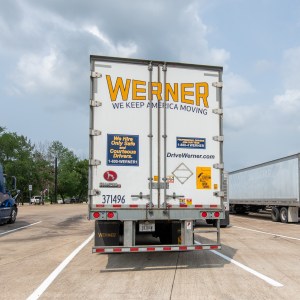
Werner Enterprises issued adjusted earnings-per-share guidance of 15 to 16 cents for the third quarter on Monday, which was significantly below the current consensus estimate of 36 cents. The company flagged 18 cents in cumulative cost headwinds from elevated diesel fuel prices, higher driver recruitment and retention expenses, and a reserve adjustment for prior insurance claims.
The company also forecast revenue of $946 million to $951 million for the period, which was only slightly lower than analysts’ expectation for $953.6 million. The news release didn’t provide any update to the company’s prior guidance around tractor counts or pricing.
Werner’s (NASDAQ: WERN) prior guidance for the quarter called for a 10% to 13% year-over-year increase in revenue per total mile at its one-way fleet. The metric was 10% higher y/y in the second quarter, with truck utilization improving 16% y/y. The outlook also called for revenue per truck per week at its dedicated fleet (80% of the TL network) to increase by 3% to 5% y/y for the full year.
Truckload fuel surcharges operate on a one-week lag. Diesel prices were up sequentially in nine of the 13 weeks of the third quarter. By month, retail diesel prices dipped 1% sequentially in July, but increased 10% sequentially in August and another 15% in September. The near-term headwind will become an earnings tailwind when prices revert.
J.B. Hunt Transport Services (NASDAQ: JBHT) issued a similar warning at an investor conference in mid-September. Its actual third-quarter results, reported last week, came in slightly better than feared. Management from the multimodal transportation provider said it is typical to incur meaningful cost increases in the early part of an upcycle, but that it remains bullish on its ability to price freight above inflation and restore margins.
SONAR: Outbound Tender Rejection Index (OTRI.USA) for 2026 (blue shaded area), 2025 (yellow line), 2024 (green line) and 2023 (pink line). A proxy for truck capacity, the tender rejection index shows the number of loads being rejected by carriers. Current tender rejections show a tight truckload market. To learn more about SONAR, click here.
SONAR: Van Contract Rate Per Mile Index (VCRPM1.USA) for 2026 (blue shaded area), 2025 (yellow line), 2024 (green line) and 2023 (pink line). The index shows a 7-day moving average of the initial reporting of dry van contract rates without fuel or accessorial charges.
Werner executives said in August that they were unfazed by the post-July 4 slowdown, chalking it up to a normal seasonal lull heading into peak season. They pointed to the TL industry’s capacity correction, aimed at removing unsafe and non-compliant drivers, as the primary catalyst for the outlook. The supply-side reduction has allowed Werner and other carriers to meaningfully raise rates this year for the first time following a nearly four-year downturn.
Werner said in September that demand among its discount-retail and food-and-beverage customers remained level from the second quarter into the third quarter, and that it was seeing elevated minibid activity at its one-way fleet.
Werner will report third-quarter results on Oct. 27 after the market closes.
Shares of WERN were down 1.1% at 10:21 a.m. EDT on Monday compared to the S&P 500, which was up 0.7%. The stock is off 31% since a mid-July peak.
Why it matters? The update shows the significant cost pressures carriers are currently facing—specifically rising diesel fuel prices and higher driver recruitment and retention expenses. It signals that the industry’s recovery following a multi-year downturn will not be linear, and that while carriers are raising rates, profitability is still being squeezed by early-upcycle cost inflation.
More FreightWaves articles by Todd Maiden:
J.B. Hunt experiences growing pains in Q3
LTL rates hit new high in Q3, moving higher in Q4
Cass: TL linehaul rates up 10% in September, shipment counts remain positive
The post Werner Enterprises issues Q3 profit warning appeared first on FreightWaves.