
Transportation prices continued to surge in September as capacity tightened further, according to a monthly sentiment survey of supply chain executives.
The Logistics Managers’ Index showed transportation prices (92.7) remained highly inflationary, up 2.7 percentage points from August. (The LMI is a diffusion index in which a reading above 50 indicates expansion, while one below 50 signals contraction.)
The pricing index has logged readings of 90 or above in five of the past six months. Record diesel fuel prices and heightened regulatory enforcement continue to restrict truck capacity, keeping the index near all-time highs.
Transportation capacity (34.4) experienced “a steep rate of contraction,” falling 5.6 points sequentially. The dataset has signaled contraction for 10 straight months. Transportation utilization (66.1) increased notably, but at a rate that was 4.5 points slower than in the prior month.
Logistics managers surveyed expect the transportation market to remain very tight over the next 12 months, returning future readings of 37.9 for capacity, 70.8 for utilization and 86.1 for pricing.
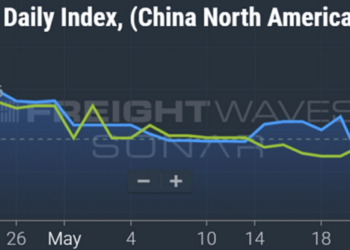
SONAR: Outbound Tender Rejection Index (OTRI.USA) for 2026 (blue shaded area), 2025 (yellow line), 2024 (green line) and 2023 (pink line). A proxy for truck capacity, the tender rejection index shows the number of loads being rejected by carriers. Current tender rejections show a tight truckload market. To learn more about SONAR, click here.
SONAR: Van Contract Rate Per Mile Index (VCRPM1.USA) for 2026 (blue shaded area), 2025 (yellow line), 2024 (green line) and 2023 (pink line). The index shows a 7-day moving average of the initial reporting of dry van contract rates without fuel or accessorial charges.
The overall LMI (70.2) was up 3.6 points in September to the second-highest level in four and a half years. (June’s 71.1 reading was the highest level recorded over that period.)
Inventory levels (58.9) increased 6.1 points, keeping inventory costs elevated at 79.9, 1.3 points above August.
The report said retail inventories are still sitting at the wholesale level of the supply chain. Upstream respondents (wholesalers and manufacturers) returned a 61.4 reading for inventory levels, while downstream respondents (mostly retailers) returned a 53.8 reading.
“This dynamic likely represents a combination of goods being rushed over late due to late-breaking confidence in Q4 consumer spending along with the neo-seasonal trend to only move goods down to retailers in mid-October,” the Tuesday report said.
“This increase likely reflects two things: first, inventories were not overbuilt in summer 2026 to avoid tariffs; second, U.S. consumers have remained strong in the face of inflationary pressures and retailers are building stocks accordingly.”
It also noted that companies have not “finished building up inventories” ahead of the holidays.
Increased inventories pushed warehouse capacity (39.3) 14.2 points lower and into contraction territory. This was the fastest rate of contraction for warehousing space since March 2022, shortly after Russia’s initial invasion of Ukraine. Warehouse capacity was nearly 10 points tighter upstream, where the bulk of the inventories sit.
Warehousing utilization (64.3) increased 4.7 points, with warehouse prices (73.5) continuing to see “robust expansion,” but down 1.5 points sequentially.
Aggregate logistics costs (inventory, warehousing and transportation) totaled 246.1 during the month, up 2.5 points sequentially.
“This is the highest reading for this aggregate metric since April of 2022, when supply-driven inflation was rampant in the wake of both the cessation of COVID-era demand and the invasion of Ukraine,” the report said. “These high costs are putting significant pressure on supply chains and consumers alike.”
The LMI is a collaboration among Arizona State University, Colorado State University, Florida Atlantic University, Rutgers University and the University of Nevada, Reno, conducted with the Council of Supply Chain Management Professionals.
Why it matters? The Logistics Managers’ Index provides a look at all major supply chain costs. The latest report signals a difficult operating environment for shippers characterized by limited capacity and rising costs.
More FreightWaves articles by Todd Maiden:
STG Logistics announces new CEO, board members
Hub Group reshuffles board amid accounting turmoil
September’s 54.5 manufacturing PMI comes with inflation concerns
The post Transportation prices surge as capacity tightens further in September appeared first on FreightWaves.