



Tender rejections are back above 14%, and Labor Day is already tightening the freight market.
In this SONAR update, FreightWaves breaks down why rejection rates are rising faster than the last three years, what that says about capacity, and why even modest demand moves can still disrupt this market. We also look at tender volumes, van volatility, and what flatbed and reefer spot rates are signaling next.
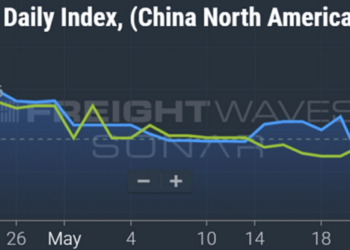
The national Tender Rejection Index has crossed back above 14% for the first time since early August, driven by the leading edge of Labor Day demand — and the move is outpacing rejection rate increases seen over each of the past three years during the same holiday window, according to FreightWaves SONAR data reviewed Thursday.
The surge comes after what many in the industry characterized as a stabilization period, during which rejection rates hovered around 13.5%. Zach Strickland cautioned carriers and brokers against reading that plateau as a sign the cycle is turning. “Stabilizing at a high level does not mean that this cycle is over,” Strickland said. “I certainly don’t think that the carriers out there and the brokers out there need to say, okay, we’re transitioning out of this.”
Strickland attributed much of the July and August demand softness to modal conversion rather than a fundamental weakening of freight volumes. Capacity, he noted, has not meaningfully expanded — it has simply stopped contracting at a faster pace than new capacity enters the market, a process he said took roughly six to seven months to play out.
“The fact that we are not seeing demand growth on this level, and yet rejection rates are jumping up higher, should tell you all you need to know about this supply-led cycle, very easily disrupted by any increases in demand,” Strickland said.
On the spot rate side, Strickland highlighted sharply divergent trends across modes. Flatbed rates remain elevated — supported in part by data center construction activity — but the overall flatbed trend line is drifting lower, which Strickland described as a market that may be “a little bit overheated.” Refrigerated rates are holding steady, benefiting from seasonal produce demand and the absence of intermodal competition that weighs on dry van. Van spot rates, meanwhile, are the most volatile of the three, swinging up and down in patterns Strickland said have not been seen since COVID-era market conditions.
Tender volumes dipped heading into the holiday as shippers pulled orders forward before taking vacations, a typical pre-holiday pattern. Strickland expects volumes to spike sharply once shippers return after Labor Day. He added that hurricane risk — normally a significant freight disruptor this time of year — appears muted for now due to an El Niño pattern that warms the Pacific and suppresses Atlantic storm activity.
The broader takeaway, Strickland said, is that tight markets amplify volatility: any incremental demand increase or supply disruption will produce outsized rate moves. “Tight markets have increased volatility,” he said. “So even if we stabilize, any nuance or disruption that comes in then becomes a little bit more volatile.” He expects van spot rate swings to remain the defining market dynamic through the end of the year.
The national Tender Rejection Index climbed back above 14% for the first time since early August, rising faster than in each of the past three Labor Day periods.Capacity has not meaningfully expanded after roughly six to seven months of contraction slowing, keeping the market highly sensitive to any demand increases.Van spot rates are the most volatile of the three major modes, with swings Strickland compared to COVID-era market conditions.
This Summary is generated thanks to a transcription of the interview, for the full interview please enjoy the video above.
The post Tender Rejections Jump 14%: Labor Day Tightens Freight appeared first on FreightWaves.