

Quick bites from the food safety arena this week
A Salmonella outbreak that has sickened more than 30 people in Finland is under investigation. The cause may be related to consumption of uncooked sprouts. In the United States, Ayco Farms recalled more than 8,000 cartons of whole cantaloupes due to potential Salmonella contamination. No illnesses have yet been reported from consumption of the melons, which were sold in Florida, New York, Pennsylvania and California.Researchers at the University of Illinois Urbana-Champaign are studying the effects of nanoplastics on Salmonella. Nanoplastics are formed when microplastics found in storage materials like polystyrene break down. Initial findings indicate that Salmonella becomes more virulent when exposed to nanoplastics. The bacteria can also become more persistent in the environment after such exposure.The produce industry is sounding the alarm on cost pressures resulting from conflict in the Middle East.FreshFruitPortal.com points to near-term cost pressure from rising diesel prices and longer-term implications of more expensive fertilizer, both driven by the disruptions in shipping goods out of the Persian Gulf. Producers are now making planting decisions based on these factors that will have ripple effects across the global economy for some time.A Swedish study of how salmon behave after ingesting cocaine sheds light on a growing threat to fish populations. Both illegal and prescription drugs are being detected more frequently in fish populations with implications for the health of the fish themselves as well as for humans who may consume them.
TODAY’S TOPIC: Mindy Brashears
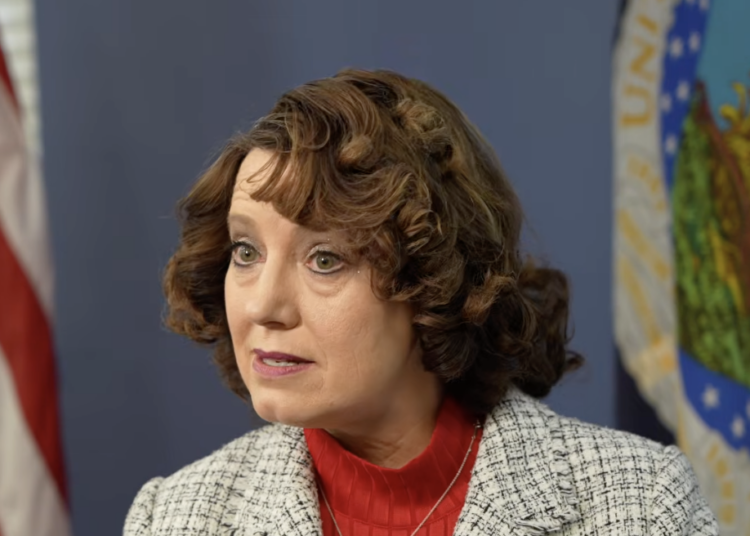
Mindy Brashears is back as Under Secretary for Food Safety at the U.S. Department of Agriculture (USDA).
“I can honestly say I am super happy to be here, and I am enjoying the job every day, but it’s not really easy every day. It’s actually difficult and a challenge,” Brashears told Food Safety News.
Late last year, on Dec. 18, the U.S. Senate confirmed the Texas Tech food microbiology scientist to serve for a second time as the federal government’s top food safety official. She last held the job from March 23, 2020, to Jan. 20, 2021.
In a wide-ranging conversation with Food Safety News, Brashears talked about the transition that involved following her successors.
“I’m very grateful to be able to say that in the food safety mission area, no matter who is at the helm for president or secretary, we can always say our mission is the same, and that’s to provide safe food for American families,” Brashears said. “So that absolutely hasn’t changed. I also agree that there’s always been a data-driven, science-based approach throughout, and so we’re. absolutely not starting from scratch.”
For 15 months before the Senate first confirmed her, Brashears headed the USDA food safety program as Deputy Under Secretary.
“There are things that were actually started when I was here the first time that finished this time,” she said. Product of USA, line speeds, and an updated approach to Listeria were among the policies she cited.
“How to retrain, regroup, and modernize our approaches to Listeria and ready-to-eat meats is, I think, extremely important,” Brashears added. “We are still collecting data, have finished collecting some of the initial data, and are regrouping on how to utilize that to move forward in a new way. So, that is really a seamless transition.”
After Brashears first stepped down as Under Secretary for Food Safety, it took the incoming administration 700 days to name Dr. Jose Emilio Esteban as her replacement and for Dr. Esteban to be confirmed by the Senate. During that nearly two-year vacancy, Deputy Under Secretary Sandra Eskin headed USDA food safety.
Bringing fresh perspective to Salmonella
In April 2024, Secretary of Agriculture Tom Vilsack took the point in announcing that his Food Safety and Inspection Service (FSIS) had finalized a policy declaring Salmonella an adulterant in raw breaded stuffed chicken products when contamination reaches one colony-forming unit (1 CFU) per gram or higher
Brashears says the Salmonella adulterant declaration is not being enforced by FSIS because it cannot be accurately measured at this time. Her focus remains on Salmonella, just with a different approach.
“Their focus was on one single product in one industry, adulterant status in raw breaded and stuffed chicken breast, and really focusing only on the poultry segment of the industry,” Brashears said. “My approach is, we’re going to be broader.”
The Under Secretary for Food Safety says, “we have to expand our lens outside of poultry” to include both pork and beef, as both are also major sources of Salmonella illnesses.
“With Salmonella, we need to push the bar higher to make sure we get to the Salmonella that are actually causing the illness, and that’s where we are going to move the bar in terms of public health metrics,” she said.
As for whether Salmonella should be declared an adulterant in meat and poultry, Brashears said: “When E. coli 0157:H7 was declared an adulterant, it was very specific to the most pathogenic types of E. coli. We didn’t just say E. coli as an adulterant; it was 0157, and then it went all the way down to the genes responsible for pathogenicity, and that’s where we have to go [with Salmonella].”
Breaded chicken products were targeted by the previous administration because they are pre-browned and cooked from a frozen state, which means there is a risk that the raw chicken component may not reach the internal temperature required to kill pathogens. These products account for about five percent of foodborne illnesses linked to chicken.
“I definitely feel that the way the previous administration approached Salmonella was important for us because it opened the door to awareness and made the industry more ready to accept some of the things that we will roll out,” Brashears said. “Salmonella is still one of my primary priorities, if not the top one, as opposed to some of the regulatory agenda items we always have to stay on top of. Salmonella is very important. So, from one administration to the next, we will always focus on providing safe food for American families.”
Brashears moved from her parents’ West Texas cotton and cattle farm to Texas Tech on a Houston Livestock Show and Rodeo scholarship. She earned her BS in Food Technology from TTU, then received her MS and PhD degrees in Food Science from Oklahoma State University, specializing in food microbiology.
Here’s what Mindy Brashears fans say:
She has a strong scientific and academic background.
Brashears is a career food scientist and microbiologist with extensive research experience in food safety, antimicrobial resistance, and pathogen reduction in meat and poultry systems. She has authored over 130 research papers, led international research teams, and holds more than 20 patents related to food safety innovations. Her academic leadership includes directing the International Center for Food Industry Excellence at Texas Tech University.
Her prior USDA leadership experience is an advantage.
She previously served as Under Secretary for Food Safety (2020–2021) and Deputy Under Secretary (2019-2020), giving her direct experience with FSIS operations. Her responsibilities include overseeing 10,000+ food inspectors and scientists, which indicate familiarity with the agency’s scale and complexity.
She is a recognized leader in food safety.
She has been honored by multiple professional organizations, including induction into the Meat Industry Hall of Fame and recognition by the American Meat Science Association. Her work has had a measurable impact on improving food safety practices in both preharvest and postharvest environments.
Here’s what her detractors are saying:
She has extensive ties to the meat industry.
Reporting shows she held numerous advisory and consulting roles with meat and poultry companies prior to her appointment. Financial disclosures indicate she owned up to $1 million worth of shares of a Texas beef processor and had affiliations with multiple industry groups. These ties have raised concerns among some observers about potential conflicts of interest in regulating the same industry.
Critics are worried about her ability to manage riskbased inspection systems.
Advocacy groups such as Beef Inspection Reform argue that current riskbased inspection practices—overseen by USDA—allow foreign meat to enter the U.S. under weaker protocols, potentially undermining consumer confidence. Although Brashears has defended the system, the criticism highlights ongoing debate about whether USDA inspection policies need reform.
The lengthy confirmation processes raise questions.
Her first confirmation took 430 days, and her second 199 days.Senate confirmation delays sometimes suggest an underlying political issue surrounding her appointment, though not necessarily reflecting on her qualifications.
Our take
We did not know of Mindy Brashears until 2017, when she was an expert witness in the BPI v ABC jury trial in Elk Point, SD. That was the trial over BPI’s $1.9 billion defamation claim against ABC over the network’s depiction of the company’s lean, finely textured beef product as “pink slime.”
With her enthusiasm, directness, and authority, those of us in the cheap seats could tell this Texan had the jury’s full confidence. ABC must have seen it too, because their top-notch lawyers negotiated a confidential settlement with BPI. Before long, reports from Wall Street revealed the settlement was for $177 million.
Brashears testified that the BPI product was beef. Period.
After Brashears stepped down for the Biden administration’s arrival, a congressional staff report on the pandemic’s impact on the meat and poultry industries depicted Brashears as a “fixer” for business interests.
“I was never interviewed for that, “Brashears told Food Safety News. “I was very blindsided by that coming out, so I did not get to respond in any manner before Congress before the report came out. I was never asked to tell my side of the story.”
Brashears was managing a crisis in the meat and poultry industries during the pandemic in 2020, which involved some temporary shutdowns. But, she says, the USDA never had to use the defense authority, which might have kept a plant open against state or local health department preferences.
Brashears breezed through her second confirmation hearing before the Senate Agriculture Committee last October.
The record of those proceedings shows that Brashers is in compliance with all ethics requirements. She sold positions that might pose a conflict and stepped from various boards and clients.
Anyone coming from the private sector to top government positions knows the drill.
She’s back for the second term. She brings her vast experience and scientific expertise to a job that is calling for a long run.
By the numbers
1994 – The year Congress adopted the USDA Reorganization Act, one of the most significant structural reforms in the history of the U.S. Department of Agriculture. The act mandates under Title VII that the President appoint, with Senate confirmation, an Under Secretary for Food Safety. A generation later, it remains the legal foundation for USDA’s modern structure. This includes recent efforts to relocate or reduce agencies by granting the Secretary of Agriculture wide latitude to reorganize agencies, delegate functions, and consolidate offices.
10,681 – A rough approximation of the number of days since the U.S. Senate confirmed the first USDA Under Secretary for Food Safety.
3,881 – The total number of days without an Under Secretary for Food Safety—equivalent to more than ten years. Some gaps occur at the beginning and end of Presidential terms. However, the biggest gap of just over six years occurred when President Obama opted not to nominate someone to immediately succeed Elizabeth Hagen, who resigned in 2013. And after President Trump was elected, the White House took two years to name Mindy Brashears, only to see the Senate hold her nomination for 402 days.
6,800 – The approximate number of days of total service by the six Under Secretaries for Food Safety prior to the current Brashears term. Those individuals, with the number of days they served are:
Catherine Woteki (1,280 days)Agricultural scientist and nutritionist Service: July 1997-January 2001Notable: First Under Secretary for Food Safety (1997–2001)Elsa A. Murano (1523 days)Director of the Norman Borlaug Institute for International Agriculture and Development at Texas A&M UniversityService: October 2001-December 2005Notable: First woman Hispanic American President of Texas A&M UniversityRichard Allen Raymond (1281 days)State of Nebraska’s Chief Medical OfficerService: July 2005-January 2009Notable: The media christened him the “germ czar” regarding Thanksgiving food safetyElisabeth Hagen (1219 days)USDA’s Chief Medical OfficerService August 2010-December 2013Notable: Food Safety StrategistMindy Brashears (365 days)Texas Tech University scientist and faculty memberService: March 23, 2020 – January 20, 2021Notable: BPI v. ABC civil jury trial, expert witnessDr. José Emilio Esteban (1132 days)Chief Scientist, Food Safety & Inspection Service, USDAService: 2023-2025Notable: Trained as a Veterinarian in Mexico, now Chief Scientific Officer for Merieux NutriSciences in North America
What it means
If you round it out, the times when the USDA Under Secretary for Food Safety has served add up to about 10 of the last 30 years. It’s a problem that needs solving.
In the past, we’ve suggested that the Under Secretary for Food Safety be appointed to a 10-year term, like the FBI Director. It would cut down on the gaps. Maybe there are other ideas out there.
We are not going to solve it now.
The good news is that Brashears has deep scientific expertise, extensive leadership experience, and recognized contributions to food safety. She spent one year as Deputy and 365 days as Under Secretary for Food Safety the first time.
She is now on track to be one of the longest-serving Under Secretaries since the office was created.
Let’s just hope there will. be enough time for her to get everything she wants done. She talks of wanting “to retrain, regroup, and modernize our approach to Listeria and ready-to-eat meats.”
She’s drawing beef and pork into the Salmonella change. And she is always “collecting data.”
This should be fun.
Do you have any comments, questions or suggestions for future coverage? Click here to give us your feedback.