
When Spartan Carrier Group founder and CEO Carlos M. Llanes Jr. started digging into artificial intelligence two years ago, his team did not buy it. Today the Fort Worth, Texas-based carrier’s vice president of operations is learning to build AI agents himself.
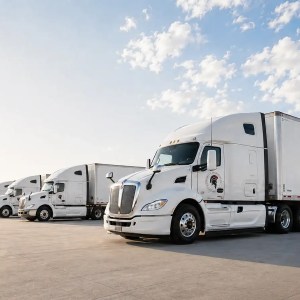
Spartan grew from zero trucks to about 150 in five years hauling just-in-time automotive freight, with Toyota as its biggest customer. It wants to keep growing with the staff it has. Its first AI agent builds the hourly customer reports that dispatchers had been making by hand. Its second, aimed at driver payroll, has not been tested yet.
Alvys launched Foundry in August to let carriers build AI agents inside its transportation management system, and named Spartan as an early customer.
Kendrick Dawson, who joined Spartan from Ryder in 2021 and is now its vice president of operations, was one of the doubters when Llanes first made his case.
“At the time, all of us looked at him like he was absolutely insane,” Dawson told FreightWaves in an interview at Trimble Insight in San Diego last month. “We’re like, bro, it’s never going to happen. What are you talking about? Where are you getting this information? Two years later, here we are.”
Growing without adding dispatchers
Spartan runs a 24/7 operation with four dispatchers: one on each shift and one who covers weekends and fills gaps. Dawson’s test for any new tool is how the carrier would double its volume without hiring another dispatcher.
“We don’t want to let anybody go, we don’t want to fire anyone. That’s not the point,” he said. “It’s how can I maximize my operation with the same headcount that I have now, and allow those people an opportunity to grow and learn to do different things.”
Dawson said many people get into logistics to solve problems, and dispatchers don’t always get the chance.
“I have a hard time believing that anybody goes into logistics because they want to look through PDF documents, or they want to look at a screen all day long and just press a button,” he said.
To teach someone a new skill, he said, he first has to free up their time.
Hourly reports became the first agent
A couple of Spartan’s customers want status updates in a set format every hour, on the hour. A dispatcher built each one by hand in Excel, which took seven to 10 minutes on average and up to 15 for a newer hire. If Spartan doubled its volume, Dawson said, the same report would take closer to 20 minutes. When he asked dispatchers in July which one task they would eliminate, every one of them named the hourly route updates.
Dawson met once with an Alvys staffer to learn Foundry and once more to hand off the report. A sample came back in about two days, and the agent was running within a week and a half. He had forgotten he switched it on until his inbox filled during the operations team’s 9:30 a.m. call.
“Literally 10 o’clock, 11 o’clock, 12 o’clock, 1 o’clock, perfectly on time,” he said.
The automated reports matched his dispatchers’ “almost 100%,” Dawson said, and he planned to start sending them to customers the following Monday. By his estimate, that one agent frees 17% of a dispatcher’s day.
“If I knock out two more that are similar in weight or capacity, I just gave them half of their day back,” he said.
The freed time also shows him what each dispatcher gravitates toward, he said, which helps him decide who takes on new projects, including Spartan’s work in Foundry.
From one truck to 150
Llanes bought one truck, then grew the fleet to five, 10, and 20 until it reached the 50 trucks Spartan’s first contract required, Dawson said. Spartan began hauling directly for Toyota in 2023 with 5% of one location’s freight. It now handles about 30% at one plant and 20% at another, he said, and is one of 12 motor carriers in North America that run directly for Toyota.
The carrier serves Toyota’s plants in San Antonio and Blue Springs, Mississippi, and works with a group at the Mazda Toyota Manufacturing plant in Huntsville, Alabama. The fleet stands at about 150 trucks, 400 trailers, and 170 drivers, Dawson said.
Driver payroll is the next test
Spartan pays drivers a flat weekly guarantee for working five days a week. Most of its freight moves on relays: a load from Detroit to San Antonio can pass through six solo drivers, with handoffs in Fort Wayne, Indiana; Shepherdsville, Kentucky; Memphis, Tennessee; Arkansas; and Dallas.
When one driver runs late, hours-of-service limits push that route later each day. Managers pull in on-call extra-board drivers to hold Toyota’s schedule, and drivers who lose a day through no fault of their own still have to be paid. Field teams sort that out by checking Samsara ELD logs and their own notes, which Dawson said usually takes an entire Monday.
“Driver workforce is the number one most important thing for any logistics company,” he said. “But in order for them to be happy, you can’t mess up their payroll.”
The workflow Spartan is building would email field teams each day with every driver missing from the dispatch planner and ask whether to log a call-off or an unplanned extra-board day. An approval would add the day to the planner and a line item to that driver’s settlement report. A weekly summary would list every decision.
It has not been tested yet, and Dawson expects it to cut payroll time at least in half.
Operators learning to build agents
Spartan moved to Alvys from a previous transportation management system that Dawson said was “not as innovation focused.” Alvys staff built Spartan’s first agent with Dawson. For payroll, he planned to start editing the Foundry workflows himself once he was back in the office, and he wants his dispatchers and field operators doing the same.
“I’m not a tech guy, I’m not a coder, I’m not a data scientist. I just run trucks,” he said.
The first template Alvys sent him needs only a customer name and a choice of report format, he said.
“If I got 25 customers tomorrow, I would just say, what template do you want, A, B, or C?” Dawson said.
Payroll is harder.
“So far, it seems relatively intuitive, but there’s some nuances that I think are a little bit difficult,” he said. Because of how intricate Spartan’s payroll is, he sees it as the real test. “If that one is easy, I cannot imagine the other ones being any more difficult. If I can get that one down, we’re going.”
Why it matters: Spartan’s first Foundry agent builds the hourly reports a four-person dispatch desk made by hand at a carrier that grew to 150 trucks in five years. It’s a growing example of fleet operators scaling through technology and automation compared to adding headcount in years past.
The post Spartan’s operators went from AI skeptics to agent builders appeared first on FreightWaves.