

The Small Business in Transportation Coalition (SBTC) has sharpened its legal arguments in its effort to force the Federal Motor Carrier Safety Administration to decertify the commercial driver’s license (CDL) programs of New York and California.
However, transportation experts say the unprecedented lawsuit faces long odds.
In filings submitted July 10 to the U.S. Court of Appeals for the District of Columbia Circuit, SBTC argued that federal law requires the U.S. Department of Transportation to decertify any state found in substantial noncompliance with federal commercial driver’s license regulations and asked the court to compel the agency to act.
The filings mark the next procedural step in SBTC’s petition after the court docketed the case last month.
Among the issues SBTC asks the court to resolve is whether 49 U.S.C. §31312 makes decertification mandatory once the transportation secretary determines a state is in substantial noncompliance with federal CDL standards.
SBTC also argues DOT unlawfully delayed acting on its May 27, 2025, petition requesting decertification orders against New York and California.
The coalition further asks the court to immediately suspend the CDL authority of both states until they are found to be in substantial compliance with federal law.
Attorney: DOT has multiple enforcement tools
Greg Reed, a transportation attorney and partner at Hanson Bridgett LLP, said SBTC’s argument rests largely on its interpretation of one word in the statute — “shall’ — but he believes the Department of Transportation retains broad discretion over how it enforces CDL compliance.
“They really hinge their argument on this particular use of ‘shall,’” Reed told FreightWaves. “But even with the use of ‘shall’ in the statute, the DOT has a significant amount of discretion in terms of how it addresses states that are non-compliant with the CDL requirements.”
Rather than requiring immediate decertification, Reed said Congress gave DOT several enforcement options, including withholding federal highway funds while states work toward compliance.
“The DOT has various tools at its disposal,” Reed said. “They might be pursued in different orders or in different manners to achieve state compliance, but there’s no requirement that a state be immediately decertified upon finding that they are not compliant with the CDL requirements.”
“You’re talking about two of the largest states for transportation, two of the largest states when it comes to CDL issuance, and the inability of these states to bring drivers into the industry would very quickly and significantly decrease capacity.”
Greg Reed, a transportation attorney
An unprecedented legal challenge
Reed said the case is unusual because FMCSA has never taken the extraordinary step of decertifying a state’s CDL program.
“It’s certainly unprecedented in the context of requiring decertification of a state’s CDL regime,” Reed said. “The Department of Transportation … has never seriously pursued decertification and has only really previously threatened withholding of funds.”
That history, Reed said, makes it unlikely a federal court would compel the agency to take such a dramatic enforcement action.
“It would certainly be a unique event for a court to force the DOT to take action as SBTC has requested,” Reed said.
Reed also questioned whether SBTC can demonstrate the type of concrete legal injury necessary to prevail in federal court.
“The prospect of further injury … is just too tenuous and remote for a court to take action on,” he said, referring to SBTC’s reliance on the fatal Virginia bus crash involving a New York-licensed commercial driver as evidence that decertification is necessary.
Petition challenges agency inaction
Reed said another hurdle for SBTC is that the petition focuses on what FMCSA allegedly failed to do rather than an affirmative agency action.
“It’s just the petition is sort of strangely postured because what they’re challenging is not what the DOT has done, but what the DOT hasn’t done,” Reed said. “Typically under the Administrative Procedure Act, we’re evaluating the actions of an agency, not the inaction of an agency.”
He suggested the litigation may be aimed as much at influencing public policy as winning in court.
“It raises a lot of questions as to whether this petition really is designed to be successful in the court of law, or whether it’s actually intended as a messaging device to put political pressure and public pressure on the DOT and FMCSA,” Reed said.
Related: Trucking group asks federal court to strip New York, California of CDL authority
What would happen to existing CDL holders?
While Reed said he believes the petition is unlikely to succeed, he also said the consequences could be substantial if California or New York were ever prevented from issuing new commercial driver’s licenses.
“I think the short answer is absolutely. It would have a huge impact,” Reed said.
“You’re talking about two of the largest states for transportation, two of the largest states when it comes to CDL issuance, and the inability of these states to bring drivers into the industry would very quickly and significantly decrease capacity.”
Reed’s assessment largely aligns with the Commercial Vehicle Safety Alliance’s view that any immediate disruption would primarily affect new CDL issuance and renewals rather than automatically sidelining existing commercial drivers with valid licenses.
Washington-based CVSA is an international, non-profit organization of government officials and industry representatives from the U.S., Canada, and Mexico.
However, CVSA said a federal decertification order would primarily affect future CDL transactions, not drivers already holding valid commercial licenses.
“A federal decertification order would primarily restrict the state licensing agency from issuing, renewing, transferring or upgrading commercial learner’s permits and commercial driver’s licenses,” CVSA said in an email to FreightWaves.
“It would not automatically invalidate every CDL previously issued by that state. Previously issued credentials generally remain valid until their stated expiration date unless the individual credential is separately canceled, suspended or revoked, or the driver is otherwise disqualified.”
CVSA said roadside inspectors verify CDL status through the federal Commercial Driver’s License Information System (CDLIS) or the Nlets database and do not have discretion to disregard a license that appears valid in those systems.
“Decertifying a state is unprecedented,” CVSA said. “It would fall upon the Federal Motor Carrier Safety Administration to issue guidance for inspectors to follow in the event of a state becoming decertified.”
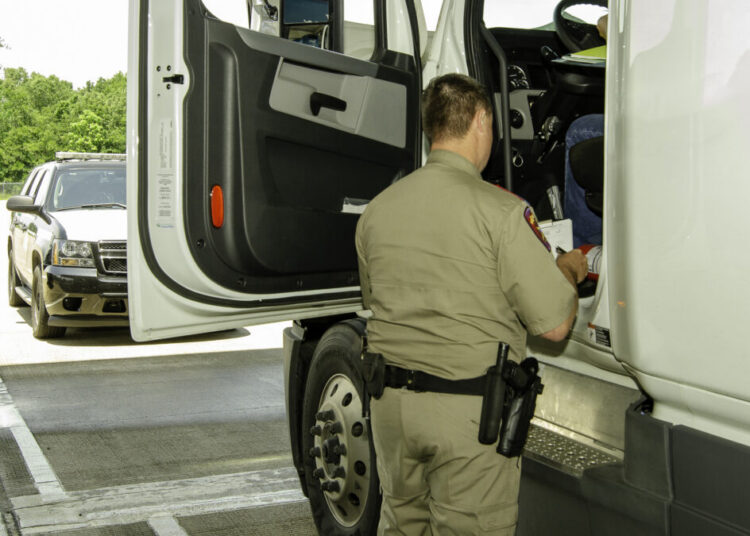
The Commercial Vehicle Safety Alliance said any immediate disruption to a state’s authority to issue commercial driver’s licenses would primarily affect new CDL issuance and renewals rather than automatically sidelining existing commercial drivers with valid licenses. (Photo: Jim Allen/FreightWaves)
Future drivers would face the biggest disruption
CVSA said the most immediate effects of a decertification order would fall on future commercial drivers rather than existing CDL holders.
“The immediate effect of a decertification order would primarily fall on future CDL transactions — including initial issuance, renewal, transfer and upgrades,” the organization said. Existing CDLs issued before a decertification order generally would remain valid until their expiration dates.
CVSA also noted that federal regulations provide a pathway for drivers living in a decertified state to obtain a non-domiciled CDL from another participating state. However, not every state participates in the non-domiciled CDL program.
“It is important to remember that the non-domiciled CDL program is not a required program,” CVSA said. “So some states do not participate and may not issue a CDL to a driver from another state.”
Case moves forward
In additional filings submitted July 10, SBTC identified the issues it wants the D.C. Circuit to decide, including whether Transportation Secretary Sean Duffy has a mandatory duty to decertify New York and California following FMCSA’s findings that both states were in substantial noncompliance with federal CDL requirements.
The coalition also filed a statement identifying the underlying agency decisions it is challenging, including FMCSA’s April 16 notice finding New York substantially noncompliant and what SBTC characterizes as FMCSA’s constructive denial of its May 2025 petition seeking decertification orders.
Separately, SBTC filed its docketing statement and certificate identifying FMCSA, the Department of Transportation and the U.S. as respondents and stating there are no related cases pending.
California’s Department of Motor Vehicles declined to comment on the litigation, calling it “a federal matter,” and referred FreightWaves to its March announcement regarding the cancellation of certain non-domiciled commercial driver’s licenses.
FMCSA, the New York Department of Motor Vehicles and SBTC did not respond to requests for comment.
SBTC’s petition to force the FMCSA to decertify the CDL programs of New York and California is not the first time the organization has tried to influence issuances of CDLs in the freight industry.
In July 2025, SBTC asked the DOT and FMCSA to repeal regulations which allow new-entrant, non-North America-domiciled carriers to apply for operating authority in the U.S., asserting that providing such authority runs counter to U.S. interests.
Related: Trucker group seeks ban on foreign motor carriers
The post SBTC faces uphill battle in bid to strip New York, California of CDL authority, experts say appeared first on FreightWaves.