

Rising fuel prices and freight rates are putting pressure on corporate supply chains, but sharply with different consequences: Higher costs for automakers, a competitive opening for railroads and an unexpected advantage for some U.S. oil refiners.
Comments from seven executives at Ford (NYSE: F), Union Pacific (NYSE: UNP), XPO (NYSE: XPO) and Valero (NYSE: VLO) during the latest third-quarter earnings season show why transportation inflation is much more than who pays more for diesel. The effect also depends on how far a company ships, which transport networks it controls and whether its competitors face an even steeper freight bill.
At Ford, Chief Financial Officer Sherry Ann House drew a distinction between the cost of moving vehicles and customers’ willingness to buy them.
“Higher fuel prices are impacting our freight and energy costs. But notably, we are not seeing it impact customer demand for trucks and fleet vehicles at this point,” House said on the company’s earnings call.
Chief Executive Jim Farley put the broader cost pressure into dollars. “We currently expect commodities, memory and logistics costs to represent a year-over-year headwind of about $2 billion at Ford.” That estimate combines several expense categories; Farley and House said growth elsewhere in the business, including software services and parts, was helping offset the increases.
For manufacturers, the burden extends beyond delivering finished products. Automotive parts can cross borders repeatedly before final assembly, leaving supply chains exposed to higher fuel costs at multiple stages.
Railroads see an opening as trucking gets more expensive
Union Pacific Chief Executive Jim Vena described the same fuel-price pressure as a potential source of new business.
“Railroads are much more efficient. It costs us way less per ton to move products across the U.S. So when fuel prices go up, it’s naturally an advantage,” Vena told investors on the company’s October 22 earnings call.
Executives at Union Pacific, Norfolk Southern (NYSE: NSC) and CSX (NASDAQ: CSX) said higher fuel costs and a tightening trucking market were helping move freight toward intermodal rail. But that competitive advantage did not eliminate railroads’ own exposure. Union Pacific said fuel prices hurt its third-quarter operating ratio by 140 basis points, as higher revenue coexists with cost pressure.
At less-than-truckload specialist XPO, executives emphasized control over transportation capacity rather than relief from market rates.
Chief Financial Officer Kyle Wismans said the company’s combined fuel, operating expense and supplies category increased 29%, or $66 million, from a year earlier, primarily because of higher fuel prices. Purchased transportation costs rose another $10 million amid increased freight volume and rising truckload rates.
Chief Executive Mario Harik pointed to the company’s effort to bring more hauling in-house. XPO reduced outsourced miles from roughly 25% when that program began to 5.6% in the third quarter, limiting its reliance on outside carriers as rates increased.
Harik said rising truckload rates were lowering the break-even point for insourcing, and the company did not expect to increase its exposure to outsourced miles. The comments suggest that owning and operating capacity can provide a buffer when buying transportation on the open market becomes more expensive.
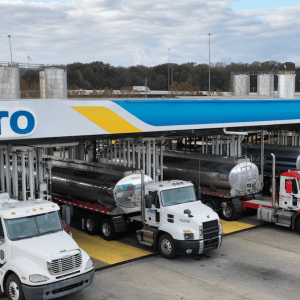
For refiner Valero, soaring tanker costs were changing the relative attractiveness of crude supplies and export markets.
“The main story right now in the market is freight rates,” Randy Hawkins, vice president of crude and feedstocks supply and trading, said on a post-earnings conference call. Shipping crude from the U.S. Gulf Coast to Asia cost $30–$35 a barrel, compared with about $5 a year earlier, he said.
Those costs have helped deepen discounts on some heavy crude grades, benefiting Gulf Coast refiners able to source supplies closer to home. Valero Chief Operating Officer Gary Simmons also identified an advantage on the sales side.
“Higher freight rates actually give us an advantage into the typical export markets into Latin America,” Simmons said, explaining that Valero primarily competes with European barrels in those markets.
Why it matters: Executives portrayed freight costs not only as a margin risk, but as a force reshaping where companies buy, how they move goods and which markets they can serve competitively.
Read more articles by Stuart Chirls here.
Read more:
Cosco profit rockets 81% as ocean freight revenue climbs in Q3
Asia-U.S. West Coast ocean container spot rates up 343% since start of Iran war, says Xeneta
Strike at Los Angeles-Long Beach port delayed as union contract talks continue
North America container imports rise 9% as as freight pricing pressures mount
Maersk raises profit outlook as earnings surge, but shares slide on expectations miss
The post Rising Q3 transportation costs squeeze manufacturers, reward railroads and reshape trade appeared first on FreightWaves.