
J.B. Hunt Transport Services is seeing heightened interest for its intermodal and dedicated services, given a steady exodus of non-compliant drivers and following the Supreme Court’s ruling widening liability exposure for brokers. The changing landscape is forcing shippers to seek “safe, secure and reliable capacity,” the company said Wednesday in conjunction with its second-quarter report, which was significantly better than analysts expected.
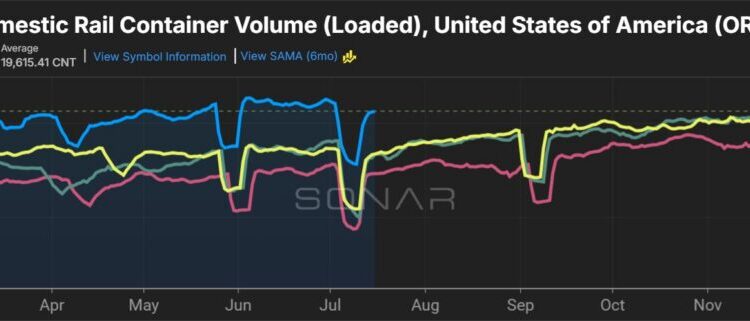
The Lowell, Arkansas-based company’s second quarter marked a record for intermodal volumes. It reported a 10% year-over-year increase in loads, outpacing 8% y/y growth in total intermodal carloads on the U.S. Class I railroads. (North American containers were up 5% y/y).
“[Intermodal] conversion activity is at levels we have not seen in more than a decade,” said Darren Field, president of intermodal, on a Wednesday evening conference call with analysts.
The company’s dedicated truckload pipeline ended the period at an all-time high.
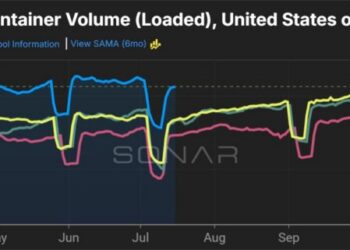
Chart: (ORAILDOML.USA). The daily volume of intermodal containers moving in the United States, Canada and Mexico. The index is a 7-day moving average using the date that containers were in-gated at a point of origin. Intermodal trailers (trailer-on-flatcar) are excluded. To learn more about SONAR, click here.
J.B. Hunt’s (NASDAQ: JBHT) operating leverage was again evident in the period. It grew operating income 32% y/y to $259 million on a 19% increase in revenue. The company has removed $135 million in structural costs over the past year through AI-led and other automation initiatives.
Revenue of $3.5 billion was ahead of a $3.26 billion consensus estimate. Earnings per share of $1.91 were 60 cents higher y/y and 18 cents above consensus. A lower tax rate and lower interest expense combined for an 8-cent tailwind in the quarter (4 cents each).
Table: J.B. Hunt’s key performance indicators – Consolidated
‘Massive opportunities’ for intermodal conversion in East
Intermodal revenue increased 22% y/y to $1.75 billion, given the higher load count and an 11% increase in revenue per load. Transcontinental volumes were up 5% y/y, with Eastern volumes increasing 16% (up 31% on a two-year-stacked comparison). By month, loads were up 9% y/y in April and May, accelerating to plus-12% in June.
Table: J.B. Hunt’s key performance indicators – Intermodal
Higher revenue per load was largely due to higher fuel surcharges. Excluding fuel, yields were up 1% y/y. However, the mix shift to the East, where lengths of haul are shorter, is masking yield performance. (Length of haul was down 3% y/y).
The company’s intermodal bid season begins every October. Catalysts for modal conversion—rising TL rates and diesel prices—weren’t present at the start of the 2026 bid season (October 2025). Management noted “massive opportunities” for conversion in the East, which is more competitive with TL. It said it typically takes cost savings of 10% to 15% to trigger conversion to the rails. SONAR data shows intermodal is currently 30% cheaper. J.B. Hunt hopes to bridge the gap between the two modes by raising contractual intermodal rates in the upcoming bid season.
SONAR: Intermodal Contract Savings Index (IMCSI.USA). The IMCSI shows the savings percentage between domestic intermodal contract rate per mile and truckload contract rate per mile. The comparison includes fuel surcharges.
The unit booked a 91.4% operating ratio (8.6% operating margin), 190 basis points better y/y. Operating income per load was up 43% y/y as its container fleet was more than 90% utilized for the first time in several quarters. It reiterated a path to the low end of its long-term margin target range of 10% to 12%. However, it flagged driver wages as a potential cost headwind as the drayage market has tightened.
Dedicated sees margin improvement ex-fuel
Table: J.B. Hunt’s key performance indicators – Dedicated
Dedicated revenue increased 9% y/y to $921 million. The increase was entirely driven by a step up in revenue per truck per week (due to higher fuel surcharges). Revenue per truck per week was 2% higher excluding fuel surcharges. The company sold service on 250 trucks in the quarter (295 trucks in the first quarter) and reiterated a full-year goal for 1,000 to 1,200 gross additions.
An 88.9% OR was level with the year-ago quarter. However, management flagged lagging fuel surcharges as a 100-bp headwind. Driver recruitment has gotten tougher, and it has had to implement sign-on bonuses and wage increases in select markets.
SONAR: Outbound Tender Rejection Index (OTRI.USA) for 2026 (blue shaded area), 2025 (yellow line), 2024 (green line) and 2023 (pink line). A proxy for truck capacity, the tender rejection index shows the number of loads being rejected by carriers. Current tender rejections show a tight truckload market.
Brokerage books first profit in 14 quarters
The company’s brokerage business turned an operating profit for the first time in 14 quarters. Revenue was up 49% y/y as loads increased 19% and revenue per load increased 26%. Management said small carriers are migrating to its platform (from small brokers) following the broker liability decision. It’s currently getting double-digit rate increases on its contractual book of business (63% of revenue in the period).
A 12.5% gross margin was 300 bps lower y/y due to elevated purchased transportation costs (54% higher y/y). Both loads per employee and gross profit per employee were off by mid-single-digit percentages. Headcount was 27% higher y/y.
Table: J.B. Hunt’s key performance indicators – Brokerage
Elevated purchased transportation expenses also weighed on its asset-light TL business, which recorded a $1.3 million operating loss.
Shares of JBHT were up 7.5% in pre-market trading on Thursday.
Table: J.B. Hunt’s key performance indicators – Final Mile & Truckload
More FreightWaves articles by Todd Maiden:
TL, LTL rates to hit new highs in Q3
Knight-Swift opens 4 LTL terminals
Analysts raise TL, LTL estimates ahead of Q2 earnings season
The post ‘Massive opportunities’ for J.B. Hunt in intermodal shift appeared first on FreightWaves.