

It’s a good sign that, after months of supply chain anxiety driven by tariffs and the Strait of Hormuz, shippers can finally welcome some mixed metaphors from shipping analysts.
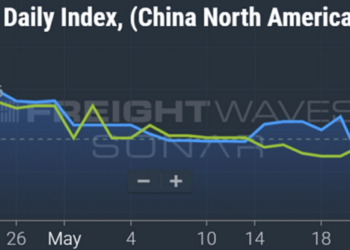
Those characterizations come as spot rates on the benchmark trans-Pacific moderated in the latest week’s data despite the now-inflamed conflict gripping the Middle East.
“It is still a very challenging market, but there is a faint glimmer of light at the end of the tunnel for shippers after spot rates remained essentially flat on major trades out of the Far East this week and carriers continue to increase offered capacity,” said Xeneta Chief Analyst Peter Sand, in an update to clients. But he warned, “This is by no means an end to the freight rate spike driven by the Strait of Hormuz crisis and further increases are expected mid-July, but these should be of a lower order of magnitude compared to the start of the month.”
Sand’s comments came before Iran and the U.S. stepped up military hostilities across the Persian Gulf.
Spot rates from the Far East to U.S. West Coast and U.S. East Coast ports still sit 276% and 232% higher since Israel and the U.S. attacked Iran in late February.
Sand termed the soaring rates as “extraordinary,” with shippers still paying multiples of what they had budgeted at the start of the year.
Spot rates are quoted for services outside of contract terms, for instance, for shipments that have been rolled or delayed. They’re a closely watched indicator that helps guide contract pricing.
Xeneta quoted Far East to U.S. West Coast rates of $7,069 per forty foot equivalent (FEU), essentially unchanged at 0.1% lower for the week ending July 10. Far East to U.S. East Coast came in at $8,808 per FEU, up a narrow 0.3%.
“What has changed is the supply side,” Sand said. “Carriers have continued to deploy more capacity into the market – Far East to U.S. West Coast is up 5.5% week on week, U.S. East Coast up 6.2% and North Europe up 3.1%. That sustained capacity injection appears to be having an effect, easing some of the pressure and helping shippers to move goods more reliably, even if it is not yet translating into lower rates.”
En toto, spot rate changes since pre-crisis end of February through July 10 are up 276% for Asia to U.S. West Coast, and 232% for Asia to U.S. East Coast.
The trans-Pacific is at the beginning of the traditional peak shipping season, said Sand, and that maritime stakeholders were taking a breather from months of pressures and spiraling costs from the follow-on effects of the conflict in the Mideast.
Sand’s pronouncement that “the Strait of Hormuz remains effectively closed to container shipping” presaged similar statements by Iran over the weekend, after it attacked a merchant container ship for the first time since May. The flaring war has already pushed up oil prices, which are likely to pressure ocean rates.
President Donald Trump contradicted those assertions, saying Monday that the U.S. could seize control of the strait and charge a 20% toll on cargo for safe passage, although observers questioned what transportation law made that provision.
Read more articles by Stuart Chirls here.
Read more:
New chief at busy East Coast box gateway
Container ship attacked in Strait of Hormuz as Iran widens war
Savannah opens last piece in project to ease port truck traffic
2M+ import containers to set new record, say retailers
Container rates near $9,000 as Iran war flares
The post Iran conflict drives up Asia-US container rate by 276% appeared first on FreightWaves.