Every truck you purchase comes with an OEM maintenance schedule. Most ELDs you install has the ability to track miles, engine hours, and time. Yet some small fleets never connect those two together. Instead, they leave maintenance up to memory, paperwork, or worse—driver recall. That’s how critical service intervals get skipped, warranties get voided, and roadside breakdowns drain your bank account. When you’re chasing loads day to day, it’s easy to push off scheduled service, but the costs of neglect always show up later, usually in the form of downtime you can’t afford.
Here’s the truth: your ELD is more than just a compliance box. It’s a digital hub that can track and trigger your maintenance schedule with precision. If you take the time to input your OEM intervals into your ELD and train your team to respond to alerts, you’ll never miss another critical service. Your trucks will run longer, your CSA scores will stay cleaner, and your cash flow will be easier to predict.
This isn’t a business extra—it’s about building a system. And in trucking, systems protect margins.
Step 1 – Start With the OEM Manual
Before you ever log into your ELD, pull the OEM manual out of your truck’s glovebox (if you don’t have it, download it). Every manufacturer lays out exact service intervals for each system—engine, transmission, aftertreatment, cooling, electrical. They don’t create those intervals just to fill pages. They base them on engineering data, warranty requirements, and real-world wear patterns.
For example, a Freightliner Cascadia with a Detroit engine may call for oil changes every 35,000 miles, while a Volvo with a D13 may require 25,000. A Cummins engine may require aftertreatment cleaning at a different mileage than a Paccar. If you’ve got a mixed fleet, you cannot assume one size fits all. Each truck has its own roadmap, and ignoring it is like skipping the directions on a prescription.
Take time to build a master list of OEM service intervals for each truck in your fleet. Don’t just copy oil changes—dig into coolant flushes, transmission service, axle lube intervals, DEF filter replacements, and more. That list is your foundation. Without it, you’re just guessing.
And in trucking, guessing leads to breakdowns you could’ve prevented.
Step 2 – Translate OEM Intervals Into ELD Triggers
Once you’ve got the list, the next move is matching it against what your ELD actually tracks. Most ELDs log three primary data points that matter for maintenance:
Mileage – exact odometer readings by VIN
Engine hours – useful for idling-heavy operations
Calendar time – service cycles that reset on months, not miles
The OEM manual will tell you whether each interval is based on miles, hours, or time. Your job is to translate that into the right trigger inside the ELD. For example:
Oil changes – typically by mileage, sometimes by hours for local delivery or high-idle trucks
DPF cleaning – by mileage or time (200,000 miles or 5,000 hours)
Transmission service – strictly mileage (250,000 or 500,000 depending on transmission type)
Coolant system checks – every 12 months regardless of miles
DEF filter replacement – often mileage plus time-based
The goal is simple: align the OEM’s rules with your ELD’s tracking capabilities. Once you get that alignment, you no longer rely on sticky notes, spreadsheets, or driver memory. The ELD becomes the enforcer.
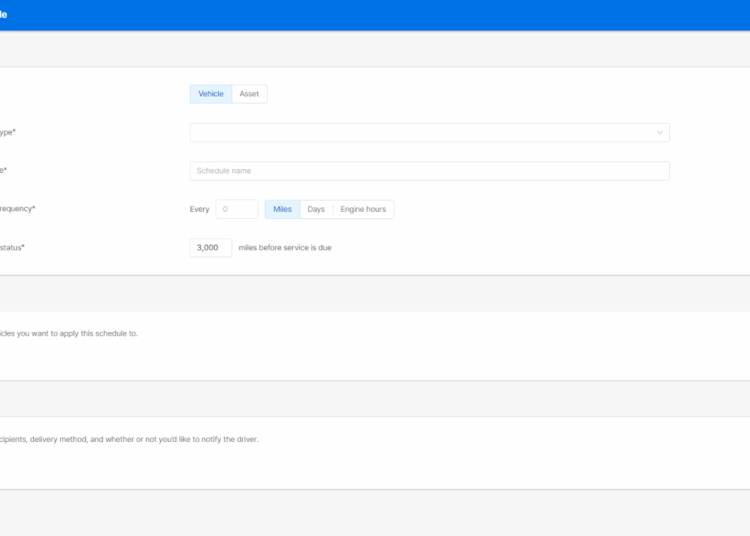
(Photo: Motive. This is what protecting uptime looks like — syncing your OEM maintenance intervals directly into your ELD platform helps you catch service deadlines before they cost you a breakdown.)
Step 3 – Set Up the ELD Maintenance Module
Some carriers don’t even realize their ELD has a built-in maintenance module. They pay the monthly subscription, but only use it for compliance logs. That’s like buying a smartphone and never setting up your calendar.
Log into your ELD dashboard and find the “maintenance,” “alerts,” or “reminders” section. From there, enter the interval rules you pulled from your OEM manual. Don’t cut corners—if it says 35,000 miles, enter 35,000 miles. If it says 12 months, enter 12 months.
Here’s the play:
For mileage-based intervals, set the ELD to trigger an alert a few hundred miles before the OEM threshold. That gives you time to plan.
For time-based intervals, set calendar alerts that auto-reset once complete.
For engine hours, treat them just like miles—schedule the reminder to fire a bit early.
Now, when a truck hits 34,000 miles, the ELD sends an alert to dispatch, the driver app, or the fleet manager dashboard. That alert is timestamped, documented, and archived. If you ever need to prove compliance for a warranty claim, DOT inspection, or insurance audit, you can pull up clean digital records with zero guesswork.
Step 4 – Layer Preventive Maintenance On Top
OEM intervals are the bare minimum. They protect warranties, but they don’t always fit the realities of your operation. That’s why smart fleets build their own preventive maintenance (PM) schedules and load them into the ELD on top of OEM requirements.
Examples of common preventive intervals you should consider adding:
Tire inspections every 10,000 miles
Brake adjustments and checks every 15,000 miles
Reefer unit service every 90 days
Alignment checks twice per year
Battery load tests before winter season
Think of it like this: the OEM manual tells you what you must do to avoid voiding coverage. Your PM program tells you what you should do to avoid breakdowns. Both live inside the same ELD system, giving you one digital calendar that tracks everything.
Step 5 – Train Your Team To Trust the Alerts
The biggest failure point isn’t the ELD—it’s your people. Alerts are worthless if dispatch ignores them, drivers push through them, or the back office treats them as suggestions. You have to build a culture where maintenance alerts are non-negotiable.
That means:
Dispatchers must schedule service the moment an alert fires.
Drivers must report trucks for service without pushback.
The back office must log completions so alerts reset correctly.
A good practice is to make maintenance review part of your weekly operations meeting. Look at which trucks are approaching thresholds and slot them into service windows proactively. Don’t wait until a truck is overdue—that’s when breakdown risk spikes and warranty coverage weakens.
Step 6 – Use Data to Build Predictability
Here’s where the payoff really shows up. When your ELD captures every service event, you’re building a record that turns into a powerful history over time. Patterns start to emerge—like which trucks are burning more oil, which drivers are idling too much, or which units are going through brakes quicker than the rest. That insight gives you control over your budget. Instead of scrambling when unexpected repairs pop up, you can forecast costs well in advance. It also makes you look stronger to lenders and insurers. A clean, well-documented maintenance record with OEM intervals logged shows lenders you’re serious about protecting your equipment, which can open the door to better financing terms. To insurers, that same record proves you’re a lower risk, which can reduce your costs.
The Payoff of Doing It Right
When you implement your OEM schedule into your ELD properly, you create an automated system that pays for itself over and over. Here’s what happens:
You protect warranties – No manufacturer will cover an engine failure without proof of service. Your ELD creates that proof.
You cut downtime – Planned service costs a fraction of roadside breakdowns. You get trucks back faster and cheaper.
You extend truck life – Well-maintained assets run longer and sell for more when it’s time to upgrade.
You strengthen compliance – DOT officers and auditors respect timestamped records more than handwritten logs.
You stabilize cash flow – Predictable maintenance costs let you budget instead of bleed.
That’s not just about trucks—it’s about running a fleet that doesn’t live in survival mode.
Final Word
Some small carriers treat maintenance like an afterthought. They run trucks until something breaks, then complain about bad luck or bad equipment. But the truth is, the OEM already gave you the roadmap. The ELD already gave you the tool. The only thing missing is the discipline to connect the two.
If you take the time to pull the OEM schedule, load every interval into your ELD, and train your team to follow alerts, you’ll build a maintenance system that never misses. You’ll cut breakdowns, keep your warranties intact, and build a stronger reputation with lenders, insurers, and shippers.
Maintenance doesn’t have to be chaos. With the right setup, it becomes predictable. And predictability is what separates carriers who survive from carriers who scale.
The post How to Implement Your OEM Maintenance Schedule Into Your ELD So You Never Miss a Critical Interval appeared first on FreightWaves.