
When it’s time for commercial flooring to be replaced, renovation teams may be inclined to toss it in the dumpster along with other construction and demolition debris, but Shaw Industries wants its EcoWorx carpet tile back.
The reverse logistics challenge
Getting that product back to the company so it can be recycled into new flooring is an exercise in sophisticated reverse logistics and effective use of freight. It comes off the floor seven to 10 years after delivery, often in small lots. By then the owner or tenant may have changed and not be aware that the flooring is recyclable or know who manufactured the product.
To combat this challenge, the Dalton, Ga., flooring maker has implemented a number of steps to make it easier for that product to be returned to Shaw rather than ending up in a landfill. For years, the company has printed a toll-free number and URL on the back of its EcoWorx carpet tile, which launched in 1999, so that demolition teams knows who to contact for product takeback.
“We also have tools within our own operations where we can identify places that we know we have had our products installed,” said Candi Hampton, vice president of global sustainability at Shaw, in an interview with FreightWaves. “That allows Shaw team members to contact them when they’re likely getting ready for renovation to ensure they are aware of our reclamation and recycling services, which are available at no cost to the customer.”
Shaw often needed a full truck or a substantial amount on a truck for it to be cost-effective to bring it back to the company.
Shaw’s answer, worked out in 2022 and 2023, was to run returns through the regional distribution centers that handle its outbound deliveries. Doing so allowed the company to collect smaller quantities from its customers and store it at the distribution center until enough material is collected to transport it to the company’s manufacturing and recycling facility in northwest Georgia. In a November 2023 release, the company cut the minimum for a no-charge EcoWorx pickup in the U.S. under its re[TURN] Reclamation Program from 500 square yards to 100.
The lower minimum fits a market where commercial spaces have shrunk, Hampton said, and floors now mix carpet with hard surfaces and unfinished or polished concrete.
Returns ride the outbound network
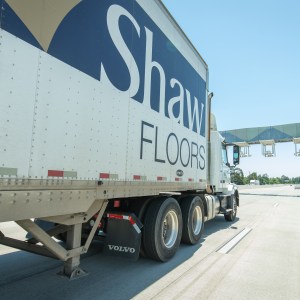
Shaw makes 2,700 customer deliveries a day and reaches 99% of the U.S. population in two days or less, according to the company’s supply chain and logistics page. The November 2023 release put its count of regional distribution centers at 30. Shaw ranks 75th on Transport Topics’ 2026 Top 100 Private Carriers list, with 689 tractors and 3,191 trailers.
That network is built around delivery dates. “If you’re building a house and trying to close, it needs to be there on time,” said Sara Martin, Shaw’s vice president of corporate marketing and communications, in a separate interview.
Most of Shaw’s truckload freight moves between its major hubs and its regional distribution centers, FreightWaves noted back in 2021. The regional centers also run local trucks that go back and forth to customers.
Those local trucks now pick up reclaimed carpet tile from customers, and customers near a center can drop it off themselves. Pickup sites still need room for a 53-foot trailer and a live load, under Shaw’s reclamation program guidelines.
“That allows us to consolidate different projects so that we have a larger footprint to then bring back to Georgia on a truck that was coming back empty anyways,” Hampton said.
Shaw still uses a couple of third-party partners where no regional center is close by, but Hampton said the distribution centers are the main route because they are more cost-effective.
Back into the backing
Once a load reaches Georgia, the tile goes into a process that chops it up, melts it and turns it into pellets. Those pellets are blended with other compounded pellets to make new backing. Shaw used to separate the fiber from the backing and use each differently.
“We’ve been able to change that process so that now everything goes into the backing, and we’re able to recycle 100% of that carpet tile back into the backing,” Hampton said.
Hampton said young Shaw engineers who had taken green chemistry classes in college built EcoWorx around principles Michael Braungart and William McDonough were promoting before Cradle to Cradle became a book or a product certification.
“If you design a product and you’re not thinking down the road what it might do at end of life, you likely don’t have very many options,” she said.
Since 2006, Shaw has reclaimed and recycled almost 1 billion pounds of carpet, including EcoWorx, according to the same release.
Recycling carpet tile counts toward a customer’s landfill diversion efforts, and using the recycled content in the manufacturing of a new carpet tile cuts its embodied carbon and the customer’s Scope 3 emissions.
Finding carpet tile installed years ago
Getting customers to send carpet tile back is the harder half. Hampton did not have a return rate to share and said it can be challenging. “There is a lot of miseducation and misperception out there,” she said.
“These products are going down. It might be seven, might be 10 years before the products are coming back up,” Hampton said. “And so the owners may have changed, the end users may have changed. They might not actually know.”
Specifications are one fix. Shaw works with architects and designers to write reclamation into product and building specs, so the instruction is on paper when the tile comes up, Hampton said.
Landfill fees decide where tile comes back
Where carpet tile and other flooring comes back from often depends on what it costs to throw it away. While recycling supports customers’ sustainability priorities, Hampton said returns come easiest where landfills charge high tipping fees: California, New York, Massachusetts and Seattle.
“Places that don’t have massive tipping fees, like Alabama or Mississippi, are harder places to get our products back,” she said.
The contractor tearing out the floor decides where the flooring goes.
“A lot of times they think it’s going to be too hard or too expensive, or it’s just so much easier to throw everything they’re demoing into a single dumpster instead of having to segregate,” she said.
Shaw has hired sustainability specialists for the Seattle and Boston areas and just added one in Dallas. Along with architects and designers, they go directly to contractors and demolition contractors, who aren’t typically the customer Shaw is engaged with when selling its products.
“So being able to have those people that can connect directly to the contractors or the demo contractors, take them step-by-step through the process, walk the space with them, really educate them, has made a huge improvement in our efforts to get product back,” Hampton said.
The post How Shaw backhauls turn old carpet tile into new opportunity appeared first on FreightWaves.