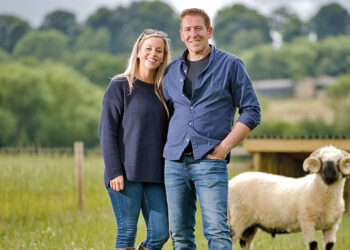


Kimberli Carroll didn’t arrive at the top of Ruiz Foods. She grew up there.
Kimberli Carroll, President and CEO, Ruiz Foods
Over 23 years, she worked her way from operations to COO to President and CEO of the largest frozen Mexican food manufacturer in the United States, the company behind El Monterey and Tornados. That kind of institutional depth is rare. It means Carroll stepped into the CEO seat knowing the business from the floor up. It also means she brought her own history to some of the biggest calls of the last two years: relocating headquarters from California to Frisco, Texas; pushing El Monterey into fusion flavors beyond its traditional Mexican food core; and making a deliberate bet on people development at a moment when most of the industry is talking about technology.
Outside Ruiz, Carroll became the first female supplier executive inducted into the Convenience Store News Hall of Fame and was named to D Magazine’s Dallas 500 in 2025. This year, we named her one of the 25 Most Influential Food & Beverage Executives of 2026.
We sat down with Kimberli to talk about the transition from COO to CEO, how Ruiz is navigating a compressed frozen food market, what it takes to stretch a heritage brand without breaking it, and why her biggest bet right now has nothing to do with technology.
Q. You spent 23 years at Ruiz Foods before becoming CEO. What did the company look like from that seat that you couldn’t see before?
Kimberli Carroll: Well, first of all, we’re a much bigger company than when I first started. I began when we were about a tenth of the size we are today. Having been a part of that journey was really helpful. I already had a much deeper understanding of how the business operated.
But when you raise up a little higher, you actually see how everything is connected in a much more meaningful way, and how the company connects in the ecosystem of the industry. That’s truly what changed most dramatically in the first two years of being in this seat.
Q. What did you have to stop doing that had served you well as COO?
KC: I think this happens to everyone at every stage of their career. In order to fully take on what’s new, you have to be willing to let go of what you were really good at before. That can be challenging, because what got you into the role are not the things you’ll do any longer. You’ll be fostering those skills in someone else.
What’s different now is that I have a very talented, seasoned team that handles everything from supply chain to manufacturing to operations. Collectively, they give me visibility into what’s happening. But I don’t manage that day to day. They lead those functions and provide the entire senior team with a clear picture of what’s working and where we need to refine. It’s stepping away from making the choices every day, stepping away from getting into the weeds, and moving into more of a governance role. We’re really good at communicating, and I think that’s been very helpful.
Q. You’ve been building out a new leadership structure since becoming CEO. How did you decide when to bring in outside expertise versus promote from within?
KC: Part of it happened organically. We transitioned from being California-based to moving our headquarters to Frisco, Texas, so we could be closer to our manufacturing locations and our customers. Some great people who had been with us a long time retired through that process. As that opportunity came available, we could see how to restructure and, in some ways, flatten the organization.
I was the Chief Operating Officer, but we don’t have one today. The senior leaders I just mentioned report directly to me, as do all the senior vice presidents. So we have an operating committee of people who really run the business every day, not an executive suite, and then leaders who run their functions. Some of it was the transition, some was retirements, and some was just seeing what the business needed in order to evolve.
Q. How do you maintain Ruiz Foods’ team culture as you bring in leaders from large CPG companies?
KC: It’s funny, because when you interview people coming from big companies, oftentimes they’re hungry for exactly what we offer. They’re looking for an opportunity to engage more on a human level, to work for a family business, and to feel like what they do every day has real influence. At the senior level, you’d expect that anyway.
This whole idea of breaking down silos and collaborating, a lot of people want that. They may have fought against it wherever they came from, and then they welcome the chance to step away and take all the things they learned about what worked.
One thing we do is what we call Birthday Club. Every month, we have luncheons at our different plant sites and here at corporate, with any team member whose birthday falls in that month. What I’m hearing from our team is that they really appreciate that we’ve hired good people and that we have a true team environment. I think it’s because being a good human is actually a criterion for being here, and that helps us be more collaborative. Our team members appreciate that they’re learning from people who aren’t closed off or siloed.
Q. You spoke at the Food Solutions Exchange about why risk scales faster than revenue. What does that mean for Ruiz specifically right now?
KC: Risk is ever-present. We do a fair amount of work on risk assessment: what are the potential risks, what’s the likelihood, what’s the potential severity. We have risk plans across every part of the business. There’s a lot of concern right now around cybersecurity, around AI, around the geopolitical environment, inflation.
But I don’t really lose a lot of sleep over risk, because we do everything we can to assess it and put measures in place to mitigate wherever possible. People ask, “What worries you?” And honestly, not a lot, for very long. The space between a problem and a plan to solve it is where the work is. And you don’t even have to fully solve the problem. Once you have a plan, you already feel better. It takes away the worry. It doesn’t take away the risk, but that will always be there.
I hope people didn’t lose too many nights of sleep over tariffs this past year, because that was so outside of anyone’s control. If it’s out of your control, you have to let it go.
Q. How has the decision-making process changed since COVID and the supply chain disruptions that followed?
KC: So much has changed. We went through COVID, then supply chain disruption, then rolled right into inflation and disruptive markets. We’re a frozen food manufacturer and supplier, and that category has been somewhat compressed over the last couple of years.
The thing that’s most significantly different now is how I like to organize my team: share all your news, good and bad, and we’ll put together plans together. I’m not one who likes to make decisions in a one-off meeting with one person. We really make those choices in our Friday meetings with input from everyone. That means sometimes legal has a point of view on what’s happening in supply chain, sometimes supply chain is weighing in on what’s happening in manufacturing. It can be uncomfortable for senior leaders initially, but what I’ve found is they actually welcome it. They want to know what’s going on across the entire business.
Every organization is systemic. Everything pulls on something else. When you can see that, when you can see that making this choice has implications upstream or downstream, you make better decisions. We’ve also connected every part of the business to a financial analyst. So we might still make a choice that’s not in our best financial interest because it’s better for the consumer or the customer, but we’re going to do it knowing exactly what that implication is. The only surprises I like are champagne and roses. No other surprises.
Q. Let’s talk product innovation. El Monterey is the number one frozen Mexican brand in the U.S. What’s the thinking behind pushing into fusion flavors like Philly cheesesteak taquitos?
KC: We’re on shelf now with Más Bold, which is our most recent launch. It’s a taquito form with a lot of unique flavors. Consumers are going to tell us how much they love that over the next few months.
The thinking was inspired by what we do with the Tornados® brand. Tornados is really fusion. We have cheeseburger taquitos. No one is trying to put us in a box, figurately speaking. They like the idea of a snacking occasion that lets them enjoy all kinds of unique flavors.
Taking that into the frozen retail category, recognizing that we’re known for authentic flavors, we felt like we had an opportunity to push the boundaries from Mexican to Mexican-inspired. Consumers are telling us they like it. And we’ve got some fun things planned for 2027, getting into new forms. I won’t say too much more because it’s top secret, but we are working on innovations that push the envelope further.
Q. How are you thinking about where frozen fits into how Americans are eating right now?
KC: There’s always an ebb and flow. Post-COVID, a lot of people had fewer dollars and were shopping the perimeter of the store rather than the frozen section. But we’re seeing a re-emergence of the desire for convenience. People love to eat out. They want to do that. But in many cases, it’s really expensive now. Even casual dining is pretty expensive now. So creating an opportunity for people to go to the grocery freezer and find wonderful, unique flavors they can make really quickly at home, thank goodness for air fryers, that’s what’s giving frozen its moment again.
And maybe it’s even the MAHA movement, because frozen is about as close to fresh as you can get. You make something fresh and then you freeze it. There’s a lot to be said for that.
Q. Where are you seeing the biggest channel opportunity right now, retail, foodservice, or convenience?
KC: Traffic has definitely been down in convenience. Rings have been up, prices are higher. A similar situation has been happening in the frozen section in retail grocery. Hopefully we’ll see some of that start to change. The winners in the current environment are club and dollar stores.
Everyone is trying to figure out how to continue to be appealing to the consumer who shops their channel. It’s really about having the right value proposition and the right product offering. You have to win on all fronts: right product, right value, consistently grabbing the consumer’s attention on repeat in order to maintain share. As suppliers, we know that’s our responsibility. We’re there to help our customers be successful by delivering the right product to the consumer.
We actually won 7-Eleven’s Food Service Supplier of the Year in 2025. We’ve been a supplier to 7-Eleven for over 22 years. I have gone to almost every one of those meetings, and I wasn’t at the one where we got the award. So I’m very proud of the team, our R&D folks, our marketing team, and the relationship we’ve built with them over all these years. It’s quite an honor and a wonderful partnership.
Q. You moved Ruiz headquarters from California to Frisco, Texas in 2023. What drove that decision and what has it done for the company?
KC: It’s certainly elevated the company’s profile. Being here in North DFW puts us on a different stage, and that’s been helpful for recognition of what Ruiz stands for and what we bring to the marketplace. It’s also created an opportunity to attract talent. It’s really challenging to do that in a small town in the Central Valley of California. The Dallas Metroplex is a different story.
The move also got us closer to our manufacturing plants and to our customers. You can get just about anywhere you need to go in half a day from DFW. And some of our equipment suppliers are right here. We can go over to their facilities and work on prototypes without even taking a flight. That’s an opportunity that’s hard to replicate.
That said, I want to be clear that this doesn’t take anything away from the wonderful team we’ve had over 60 years in California. We are all standing on the shoulders of giants, because they’re the ones who built the company to what it is today.
Q. How are you honoring that history and the company’s roots as you grow?
KC: We still celebrate quite a bit at our plants. Next week I’ll be traveling to the first of our town hall meetings. We go in, we celebrate with the team members at our manufacturing plants, and we host a fiesta, because we’re a Mexican food company. We have town halls throughout the day so we can interact with the team, and the following day, team members bring their families and we have fiestas on site at each location. We do a road show because we do this at every plant.
It’s a spring celebration. An opportunity to thank the team for the contribution they make to the business, and their families for the support they provide. It honors the family and the heritage, and I think it’s one of the things that helps continue to foster our culture.
Q. You were the first female supplier executive inducted into the Convenience Store News Hall of Fame. What did that recognition mean to you?
KC: It’s such an honor, and I’m so grateful that my name is on it. But honestly, it’s an honor for the company. Well before I was at Ruiz Foods, the convenience space was where we got some of our start. We were making tamales and putting in tamale steamer programs for small-format convenience stores, mom and pop stores, way back in the 80s and 90s.
I was actually surprised I was the first woman. I didn’t realize that. I celebrate it really more for the company than for myself, but I’m grateful I’m right there. I’ve championed the growth of convenience store food service throughout my career and I’m grateful for that opportunity.
Q. When you look at women coming up in food manufacturing leadership, what do you see?
KC: I see smart, capable people, men and women. When I was very young, I would often be the only woman in a room of 15 or 18 men, and always the youngest. Unfortunately, now I’m often the oldest. But the good news is I’m never the only woman. I think we’ve jumped to 30 to 40% at least.
Even if we consider this still to be somewhat of a male-dominated industry, women are contributing at all fronts. They’re retailers, they’re suppliers, they’re involved in data, they’re helping reimagine what success in inside food sales can look like. I’m excited for all of us that there’s still opportunity.
Q. What’s the biggest bet you’re making at Ruiz right now that the industry will only understand in hindsight?
KC: It might be a little bit of a departure from what everyone else is doing. We’re investing in technology. We’re investing in AI. We’re looking at how we’re going to refine. But we’re also truly, dramatically investing in our people. And I don’t hear a lot of folks talking about that.
We’ve made a deliberate choice that we want to see if we can upskill and develop our own team before we go outside. We want high performers in every part of the business. But what we’re building is a learning and development program, not a training and development program. The difference matters. Training is a push. Learning is something you agree to receive.
We’ve also put together programs intended for leadership development and various levels of the business. We have three areas we call Edge, Salsa, and Lead, and those are really about leadership development. We’re betting that we’re going to win not just because we’re investing in technology, but because we have the best team.
Q.What advice would you give other food executives making a similar bet right now?
KC: Stay the course and don’t give up. That’s true even when it comes to rising through the ranks.
You’re going to hit roadblocks. There are going to be people who aren’t advocating for you. There are going to be problems. When you give up too soon, you don’t know what you’re capable of.
But if you really believe in your mission, if you believe you can make something happen, you just have to ride through all of that to the finish line.