

The Headline Number: Spot Rates Hit an All-Time Record
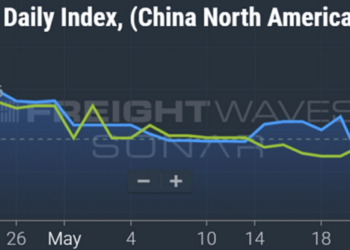
Craig Fuller set the tone in the opening minutes, and the data backed it up at the close. The SONAR National Truckload Index, which tracks daily spot rates inclusive of fuel, hit 383, an all-time record. Fuller, a self-described rate nerd from a trucking asset background, did not hide his enthusiasm: after years of carriers living in the doldrums, the market has turned toward them, and this is their cycle to do better.
The more important chart for owner-operators came when Fuller stripped fuel out of the number. Looking at linehaul-only rates, the surge that began back in November becomes even clearer, because that is what carriers actually see in terms of cash flow. The rate strength is real, and it is not just a fuel-driven illusion.
The Fuel Story Underneath the Rate Story
Here is the piece that most coverage will miss and that the show spent real time on. Diesel ran up to $5.54 a gallon at the pump after the war-driven spike from $3.75, but it has been cooling off over the last couple of weeks as resolution noise calms the market. That is relief for any carrier buying diesel at the pump.
But Fuller drove at something more specific and more valuable. The wholesale rack price of diesel, what the bigger carriers pay through cost-plus relationships, has cooled off much faster than retail diesel. The spread between wholesale and retail has blown out to a record $1.78 per gallon. Carriers buying fuel on wholesale cost-plus arrangements are billing out fuel surcharges at retail prices while buying at deeply discounted wholesale, and that gap is turning into a meaningful margin gain. Fuller’s read: this is why a lot of truckload carriers are going to beat earnings this quarter, and Wall Street consistently misses the fuel surcharge story. He pegged it at roughly an 11-cent-per-mile move, about a 3% margin improvement showing up in operating ratios this season.
Webb Estes: “A Very Different Industry Than Even Three Months Ago”
The first guest was Webb Estes, president and COO of Estes Express Lines, fourth-generation leadership at one of the great privately held names in LTL. His operational read was striking. Last week was a record for Estes, with tonnage up roughly 7.5%, after the company had been essentially flat just two months earlier. His description of the shift was the line of the segment: it is a very different industry than even three months ago, and capacity is genuinely hard to find right now.
Estes pointed to the structural forces, non-domiciled CDLs being removed across states and the Supreme Court ruling, while being honest that he does not have every cause pinned down. What surprised him most was retail. He expected retail to struggle with higher prices and fuel, and instead both retail and manufacturing are running strong at the same time. Grocery, construction, and the broad consumer base are all moving.
There was also a master class in long-term thinking buried in the conversation. When Yellow went under, Estes bought 52 terminals for $490 million and roughly 7,000 trailers at an average of $5,000 each, against a $40,000 replacement cost on a new pup, a move Estes estimated saved around $230 million. The lesson for any operator listening: being debt-free and privately held let them say yes to opportunity before they technically needed it, and position for the next 95 years rather than the next quarter.
The Fraud Segment: Highway and the New Rules of the Exchange
The fraud conversation with the expert from Highway was one of the most useful segments for any carrier trying to understand why the load board feels different now. Freight fraud is hitting epidemic levels in the age of AI, and the response is changing how carriers access freight.
The core idea: Highway operates like an exchange with rules. No ghost loads, no manually posted phantom freight, and the truck has to be observed on the telematics device and on the insurance policy to even see the load. Carriers used to a world where they could log in and search and see anything are running into a model where they only see what they are actually qualified to haul, described as the same suggestion engine that sits under Netflix, but for freight matched to a carrier’s insurance, patterns, and movement.
That restriction is exactly why Highway has taken heat from small carriers, and the expert did not dodge it. The frustration is real, but the loads a qualified carrier does see are specifically for them. And the demand signal is shifting fast: shippers, including one of the largest retailers in the country, are now calling to make sure the truck showing up at their facility is the actual truck tied to the carrier. The verdict on brokers: large brokers stand to gain, chaos always favors the broker, and a lot of small brokers will likely roll into agency models.
Shelley Simpson: “He Who Has the Driver Wins”
JB Hunt president and CEO Shelley Simpson brought the perspective of one of the most powerful operators in the industry, and her framing of the current capacity environment was measured but pointed. She would not call it a crisis, but she called capacity fragile, and got specific about where it is tightest: the Ohio area and the broader Midwest, Texas tighter than it has been historically, and pockets in the Northeast and Washington.
Simpson leaned on JB Hunt’s identity as a company founded by a driver, Mr. Hunt himself, celebrating 65 years this August, and on the Kirk Thompson line that has guided the company: he who has the driver wins. As the supply side gets more fragile, she described routing guides breaking down for customers and the spot market feeling the strain, and made the case that JB Hunt does its best work for customers precisely during these crunch periods because it locks in with them rather than chasing short-term freight.
She also gave a clear window into the asset-versus-brokerage balance that defines JB Hunt’s model. The company runs five business units independently with different margin targets, and will steer freight to a contract carrier rather than its own assets when that fits the customer’s network better, sometimes quoting both an asset price and a brokerage price and letting the customer choose. Fuller’s aside, that brokers trying to bolt on assets have bled out trying, Convoy among them, while starting from the asset side is a structural advantage, landed as a real strategic point for anyone thinking about where durable freight businesses come from.
Gene Seroka: The Port View on Tariffs, Retail, and the American Consumer
Gene Seroka, executive director of the Port of Los Angeles, the busiest container port in North America for 26 consecutive years, closed the guest lineup with the global trade picture. His barometer reading: LA is down about 2% in total volume versus a very strong 2025, but up about 2% against the five-year rolling average. Translation, the American consumer and American manufacturer have held up stronger than many expected through all the volatility.
Seroka confirmed Estes’s retail surprise from the import side. People are still spending, but bargain hunting hard to stretch the family budget, with gas up nearly 30% and Southern California diesel up 50% weighing on everyone’s mind. The big question he flagged for the back half of the year is how much affordability pressure hits the all-important holiday season.
On tariffs, Seroka gave the most sober assessment of the day. Roughly $170 billion in collected tariffs sits in question after the Supreme Court’s February decision, money that could smooth the economy if redirected but has not reached consumers. He walked through the expiring Section 122 tariffs set to lapse July 24, the looming Section 301 investigations that will be far more commodity-specific than the sweeping IEEPA tariffs, and the real-world trade damage already visible: US soybeans to China down 90% year on year, with Brazil and Argentina filling the gap, almonds shifting to Australian sourcing, pistachios moving from other origins into India. His ask of policymakers was simple and quotable: tell us the ground rules so we can get to work, because the stops and starts and whipsaw are what actually impede growth.
The Bottom Line From Day One
Strip away the launch-day jitters and the picture that emerged was remarkably consistent across an LTL operator, a fraud and technology expert, the CEO of one of the largest truckload carriers in the country, and the director of the nation’s busiest port. Capacity is tightening fast. Retail is stronger than anyone expected. Fuel is cooling at the pump and cooling even faster at the wholesale rack, quietly padding carrier margins. And the structural forces of compliance enforcement and the broker liability ruling are reshaping who gets to haul freight and how.
For the small carrier and owner-operator, the message under all of it is the one Fuller kept returning to: after a long, brutal downturn, this is the cycle that finally turned toward the people who move the freight. The question now is who is positioned to make the most of it.
That is exactly the kind of state-of-the-market read the show is built to deliver, and Day One was only the start. The full premiere replay is embedded above, and the segments with Estes, Highway, Simpson, and Seroka are each worth watching in full, because the detail in those conversations is where the real value lives.
FreightWaves Today airs live at noon Eastern every weekday, with rebroadcasts on the RoadDog Network at 5 PM, plus 6 AM and 8 AM the following morning. Day Two raised the stakes with Aaron Graft, CEO of Triumph, one of the most important banks in the freight business, joining the desk, and the rest of the week brings a lineup the team is promising will not disappoint. If Day One is any indication of how fast this market is moving, you will want to be watching live. Catch the replay above, then meet us back here tomorrow at noon.
The post FreightWaves Today Debuts as Spot Rates Hit a Record appeared first on FreightWaves.