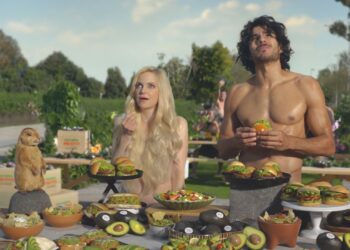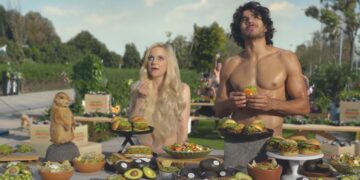

Loewe | Loewe
There was a time, not too long ago, when a purse shaped like a baguette felt like a thrilling — even subversive — novelty. Now, we hardly bat an eye when we see that Moschino has made a trompe l’oeil celery purse, or that Big Bud Press is making a hot-dog-and-pretzel-print jumpsuit in collaboration with a Los Angeles bar. How did we get here? And has it all become a little too much?
Fashion has long found inspiration from the culinary world, but the influx of food-fueled prints, graphics, and trompe l’oeil accessories that picked up steam during the pandemic have now reached a cultural tipping point.
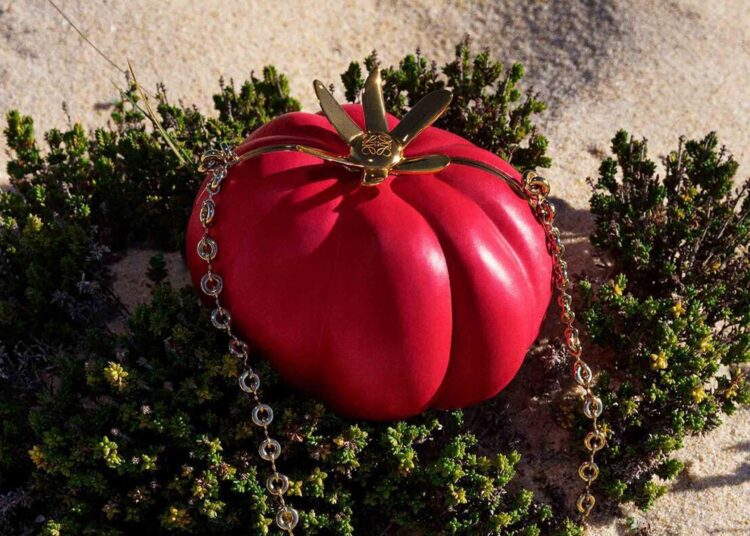
Today, there are truly countless examples of these food motifs and edible, wearable trompe l’oeil creations, at all price points. Loewe’s summer collection featured a $4,150 lambskin tomato clutch, while Walmart’s included a line of rotisserie chicken bag-like purses and charms starting at $5.97. As with many trends, this trajectory started in high fashion and worked its way down to mass-market ubiquity. In 2020, a chocolate chip cookie went down one of New York Fashion Week’s most buzzed-about fall runways. It protruded from a black purse by the designer Puppets and Puppets, a design that quickly went viral for its whimsical inclusion of a classic dessert on a high-end handbag.
The then-emerging brand made food a central theme of its vision: Its cake-topped aviator caps, Ferrero Rocher heels, and beeswax-sculpted cheese hats — hyperrealistic, absurdist food designs capable of achieving instant social media virality. Prior to working in fashion, Puppets designer Carly Mark was working as an artist whose pieces revolved around candies and snacks. As she told Business of Fashion in 2023, the Puppets universe felt like the ideal pairing given what she considers food and fashion’s motivators: pleasure and money.
During the pandemic, the much-duped “strawberry dress” took over TikTok, and Tombolo Company found a hit on its hands with its vongole shirt, which debuted in 2019, but found peak popularity in 2021. The shirt appeared in Vogue in 2020, and InsideHook called it an “obvious bedfellow to day-drinks, rooftops and weekenders” — in other words, a status symbol. Katie Kimmel’s T-shirts made chicken-parm enthusiasm akin to being a devout sports fan, and in 2022, this very publication called “seafood kitsch” the look of the summer, as items like Rachel Antonoff’s super-popular seafood-tower dress flew off the digital shelves.
Why was food so primed to become a motif in clothing at this point in culture? One could make the argument that it has roots in the millennial optimism years: Earlier in the 2000s and 2010s, the concept of “foodies” was new. Brands printed tongue-in-cheek food- and coffee-related motifs and slogans (a fervent love of avocados comes to mind) on hipster apparel, as the idea that “you are what you eat” developed growing fervor. That period was a key stepping stone in the evolution toward the far more elaborate and pervasive marketability of food-as-identity we see today. Content creator Cole Poska, who is a partner and creative director at Beyond Studios, tells Eater that “food brands have something most brands would kill for: decades of nostalgia, iconic identities, and consumers who are borderline obsessed with them.” Poska’s own Instagram often reimagines restaurant merch just for fun; his designs for Cheesecake Factory apparel went viral, such as a hat that resembles the iconic brown bread. He points out that people will defend their favorite fast-food order like it’s a family member, and with the kind of loyalty that’s hard to manufacture. The same could be said about their martini order, or favorite taco spot; it’s all a way of telling others who we are through what we like.
But the fatigue is undoubtedly here. In 2024, Bon Appétit asked “Why Does Every Dress Have Pasta and Cocktail Shrimp on It?” And as the novelty factor of a shrimp-print dress has worn off, the next question might be: Will there be any true longevity for these food-as-fashion moments? Our feeds overflow with products that are hurriedly designed for flash-in-the-pan viral trends and quickly destined for a landfill; arguably more so if the object in question prioritizes shock value and gimmicks over function and brand identity.
This is undoubtedly all related to the accelerated speed of trend cycles and shortened consumer attention spans. However, as Leah Asmelash wrote last year for CNN, the rising costs of food also casts an increasingly sinister shadow over food-themed fashion. In 2026, a $425 cardigan emblazoned with oysters has waning originality compared to a few years ago; it falls into banality at best and the Hunger Games at worst; its wearer indicating that they’re financially comfortable and, more importantly, well-fed. In that light, beyond its role in identity, food has become more of a status symbol than ever. A sweater touting one’s love of caviar is shorthand for their access to and appreciation of luxury, culinary and otherwise. But sporting the mass-market Temu version? It’s more akin to wearing a faux Gucci belt.
“Food brands have something most brands would kill for: decades of nostalgia, iconic identities, and consumers who are borderline obsessed with them.”
Cole Poska
If it’s possible to escape the sense of accelerated-trend-cycle disposability, it may have to be through a more subtle approach than, say, a bag that looks like a giant stick of butter. Sam Salad is the co-founder of Meals, a Los Angeles-based, workwear-inspired apparel company that, by its own description, “bakes ‘food culture’ into apparel, blurring the lines between the clothes we eat and the food we wear.” Utility is at the forefront of Meals, which offers a classic chef pant with a slightly fuller cut, in both basic colors and subdued aesthetic homages to blue cheese and watermelon. When Meals launched in 2019, Salad was selling premium denim along Venice’s Abbot Kinney Boulevard, a hotbed of Instagrammy food culture and trendy restaurants like Gjelina that helped inspire his own brand. “Design today has to translate across languages and platforms,” Salad tells Eater.
Food is hardly a new bedfellow for fashion designers, even if today’s hyper-fast trend cycle has kicked it into overdrive. “Food is totally universal,” Salad says. “Issey Miyake once merchandised their pleats collection as little omakase sets.” He cites that collection among other fashion-meets-food moments that he considers successful, such as the iconic Salvador Dalí- and Elsa Schiaparelli-designed lobster dress. At the time of its 1937 creation, the dress was a scandal: It assumed a conformity-defying sartorial stance and was fittingly worn by Wallace Simpson. Today, its highly devolved spawn are available on Shein for $13.
As it stands, one clear way out of corny, food motif purgatory is for brands — fashion or food — to focus less on quantity and more on storytelling and quality. “We do a few things really well, and that’s enough,” Salad says, “Like In-N-Out [Burger].”
Poska’s philosophy is similar. “I’d rather make one thing people talk about for a year than 20 things people forget about tomorrow,” he says. “The first person to make a candle look like a stick of butter is a genius. The hundredth person is just making a candle.”