
Welcome to this week’s Food Exec Brief, your strategic intelligence roundup for food and beverage manufacturing leaders. This week, we’re covering:
Manufacturing expanded for the fourth consecutive month in April, but input prices just reached their highest point since April 2022.
The Middle East conflict has triggered a fertilizer supply crisis and a biofuel demand surge. The food price effects won’t peak for another 12 to 18 months.
The USDA is proposing to let pork and poultry facilities under modern inspection systems set their own line speeds.
The FDA’s new one-day inspectional assessment pilot has completed 46 screenings in its first weeks, most with no action required.
AI machine vision in food packaging is now exceeding 99% defect detection rates. Cold chain facilities are a different story.
Kraft Heinz is deploying $600 million starting with packaging, as new research ties 1,000 tonnes of annual microplastic migration to plastic food packaging.
Financial: A hot Prices Index and a cooling labor picture
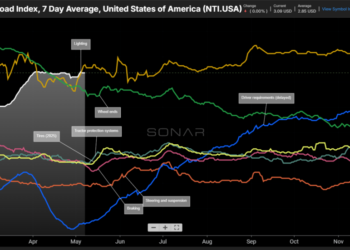
The ISM Manufacturing PMI held at 52.7% in April, marking the fourth consecutive month of expansion. The Prices Index jumped to 84.6%, a 6.3-point increase from March and a 25.6-point run-up over the last three months, its highest reading since April 2022. New orders continued expanding, registering 54.1% for the fourth straight month. But the Employment Index fell to 46.4%, down from 48.7% in March, with factory hiring continuing to contract. Supplier delivery times also extended for the fifth month in a row, with the Supplier Deliveries Index rising to 60.6%. (Learn more)
In California, overlapping pressures are pushing prices higher across the entire supply chain. Rising fuel and fertilizer costs, water shortages, trade disruption, and regulatory requirements are forcing farmers to cut acreage and switch crops. Grocers operating on thin margins warn that energy expenses and potential SNAP reductions could push costs even further onto consumers. Economists and policymakers describe the situation as a regional concentration of a national and global 2026 pattern rooted in geopolitical instability and sharply higher agricultural production costs. (Learn more)
Why it matters: Manufacturers are absorbing the fastest input price acceleration in four years while simultaneously reducing factory headcount, building the conditions for a capacity gap that demand recovery will expose.
Regulatory: Line speed deregulation and a faster FDA inspection model
The USDA’s Food Safety and Inspection Service has proposed letting pork and poultry facilities operating under modern inspection systems determine their own line speeds, replacing federally prescribed maximums with a performance-based standard. Under the proposal, New Swine Inspection System establishments would be permitted to set their own rates based on their ability to maintain process control, with FSIS retaining authority to order reductions when inspectors determine that control has been lost. For poultry, the proposal would allow young chicken establishments under the New Poultry Inspection System to operate at up to 175 birds per minute, and would increase the turkey maximum from 55 to 60 birds per minute. The proposal also removes requirements for annual attestations under both programs. (Learn more)
The FDA has launched a one-day inspectional assessment pilot, with approximately 46 assessments completed by late April, most resulting in No Action Indicated outcomes. The program is designed to complement standard FDA inspections rather than replace them, with investigators retaining authority to expand scope when warranted. Facilities are being selected based on product type, prior inspection outcomes, and operational characteristics. Commissioner Marty Makary described the model as enabling broader surveillance coverage while reducing disruption for lower-risk facilities. The pilot covers human and animal foods inspectorates, biologics, medical products, and clinical research programs, and runs through the end of fiscal year 2026. (Learn more)
Why it matters: The USDA’s line speed deregulation and the FDA’s faster, lighter inspection model are moving in the same direction at the same time, and both shift more responsibility for process control onto manufacturers.
Supply chain/tariffs: A fertilizer shock with a lag, and biofuel demand making it worse
The Middle East conflict is generating a slow-moving food price shock that most supply chain models have not fully accounted for. According to an RBC analysis, the World Bank now expects global energy prices to jump roughly 24% in 2026. Fertilizer prices are projected to rise 31%, with roughly a third of global fertilizer trade flowing through the Strait of Hormuz. Urea, a fertilizer critical to crop yields, rose 86% in March 2026 compared to the same time a year earlier, including a 53% jump since February alone. The International Grains Council expects farmers to plant fewer acres heading into the 2026-2027 season, tightening grain balances. The downstream effect on food prices from fertilizer cost increases typically arrives with a lag of several months to a year. (Learn more)
The oil price shock is also accelerating biofuel demand in ways that compete directly with food commodity supply. As crude oil prices have risen with the Iran conflict, energy markets have pushed harder into biofuels, which are produced from crops that overlap with the food supply. EU biodiesel production uses 39 to 44% crop feedstocks. Globally, approximately 16% of corn and 22% of sugarcane is converted to ethanol. The crops most affected, including vegetable oils, corn, and palm oil, are core food manufacturing inputs. Structural biofuel demand policies in the EU, Brazil, and Indonesia mean this competition for crop feedstock is a durable market condition, not a temporary spike. (Learn more)
Why it matters: The fertilizer price shock and biofuel demand surge both operate on a lag, which means their full impact on food input costs will land inside planning cycles that are already set.
Technology: Machine vision clears 99% accuracy, and cold chain near-misses go unreported
PMMI’s 2026 report on AI in packaging equipment confirms that machine vision has moved well past its early limitations. According to the report, defect detection rates now exceed 99% while false rejection rates have dropped by up to 50%, reducing both waste and throughput interruptions. Machine vision ranks among the top five AI applications delivering measurable results in packaging, alongside predictive maintenance and digital twins. The report also identifies the biggest remaining barriers to efficiency gains across food and beverage plants: lack of visibility across sites and inconsistent reporting that slows operations and increases downtime. AI-powered connected worker platforms are beginning to address both at scale. (Learn more)
In cold chain operations, the most actionable safety signals are appearing well before any reportable incident, and most facilities are not tracking them. In ammonia refrigeration systems, near misses include repeated alarms in the same area and alarms that operators have stopped treating as urgent. These are early indicators of thinning barriers, drifting operating discipline, and aging equipment. Cold storage leaders who use near-miss data as a primary process safety input are better positioned to prevent high-consequence refrigeration events. A facility with very few near-miss reports on file is more likely reflecting a reporting culture gap than an absence of risk. (Learn more)
Why it matters: Machine vision is making inspection more accurate and less labor-dependent at the same time that cold chain operators are leaving one of their best safety tools unused, and both have concrete cost exposure attached.
Sustainability: A Scope 3 backslide and a new upstream decarbonization model
General Mills reported that total greenhouse gas emissions fell 14% in fiscal 2025 against its 2020 baseline, a step back from the 19% reduction achieved in fiscal 2024. The company’s 2026 Global Responsibility Report attributes part of the reversal to electricity usage at an acquired production facility, which drove a 3% year-over-year increase in operational emissions. Suppliers account for two-thirds of General Mills’ enterprise greenhouse gas emissions, making their cooperation central to the company’s goal of a 30% reduction by 2030. On the positive side, all 37 General Mills production facilities reached zero-waste-to-landfill status by the end of fiscal 2025. (Learn more)
PepsiCo has executed its first low-carbon ammonia attribute agreements, targeting fertilizer decarbonization across its global agricultural supply chain. The collaboration with agriculture technology company TalusAg covers approximately 30,000 metric tons of low-carbon ammonia across PepsiCo’s Europe, Sub-Saharan Africa, Asia Pacific, and global teams, with an option for an additional 41,000 metric tons. PepsiCo describes the agreements as a market-based mechanism for near-term, auditable emissions reductions while preserving affordability for farmers, noting that fertilizer production is among the most emissions-intensive components of the food system and occurs upstream of direct supplier relationships. (Learn more)
Why it matters: General Mills’ backslide is proof that you can optimize every facility you own and still miss your 2030 targets because two-thirds of your emissions are controlled by suppliers outside your org chart.
Packaging: A $600 million investment case and a growing material risk
Kraft Heinz CEO Steve Cahillane, who took the helm in January 2026, has redirected the company’s capital strategy toward internal operations, with packaging as the primary early focus. Cahillane described specific product lines where functionality had fallen below consumer expectations, particularly resealability and shelf performance for cold cuts and deli products, and framed the $600 million deployment as “dry powder” to address structural weaknesses rather than growth. The company reported Q1 2026 adjusted operating income of $1.1 billion, down 11.8% year over year, citing inflationary pressures in manufacturing and logistics that outpaced its efficiency efforts and unfavorable volume and mix. (Learn more)
A study from Earth Action and rePurpose Global found that 1,000 tonnes of microplastics and nanoplastics migrate from plastic packaging into food and drinks annually. PET bottles account for approximately a third of total packaging-related exposure. The amount of microplastic released varies based on pack design, material type, and storage conditions including heat and UV exposure, meaning formulation and packaging decisions compound each other. Manufacturers already working through EPR requirements and sustainability commitments now face a third dimension of packaging pressure that is showing up in consumer awareness and early regulatory interest simultaneously. (Learn more)
Why it matters: Kraft Heinz’s $600 million bet and the microplastics data both suggest that packaging has become a product quality and brand risk issue.
The Food Exec Brief provides weekly insights for food and beverage manufacturing leaders and publishes every Friday.