



Shippers may not have it so easy finding capacity moving forward. Upheaval across the supply side of trucking has shifted market balance even without a meaningful uptick in demand.
Truckload carriers culled their fleets as part of broader cost-cutting initiatives through the prolonged downturn. Many have also lowered exposure to the “you-call, we-haul” model, in favor of dedicated contracts that can cover the useful life of a tractor. Add in constraints from heightened regulatory enforcement of the driver pool, and shippers may be entering a much tougher period of capacity procurement.
Capacity exodus likely a for-hire event
English-language proficiency requirements, non-domiciled CDL restrictions, a crackdown on ELD providers and forced closures of driver schools are tightening the screws on capacity, which had been loose for over three years.
Derek Leathers, chairman and CEO at Werner Enterprises (NASDAQ: WERN), said the trucking industry is “only in the early innings of some of this regulatory constraint on capacity,” at Citi’s 2026 Global Industrial Tech and Mobility Conference in Miami on Tuesday. In addition to operators being forced from the industry for “coloring outside the lines,” he said the threat of regulation has likely deterred many more from entering.
He estimates that of the 3.5 million professional truck drivers in the U.S. as few as 1 million are seated in true for-hire, over-the-road configurations. With industry estimates pointing to 250,000 to 400,000 drivers being forced out, many of which are operating in the one-way market, the shift in the supply-demand dynamic could be significant.
“There’s significant over-the-road capacity leaving that one-way market,” Leathers said.
Leathers also noted that roughly 7,000 of the nation’s 17,000 driver schools have been cited for noncompliance. Those unable to correct course will be forced to close, placing an “external lid on supply growth” at the top of the funnel.
His forecast also calls for replacement-level (or below) Class 8 tractor builds this year. It took the OEMs 18 months to ramp production coming out of Covid, but they are now also juggling new suppliers given new engine standards. He thinks the OEMs are unlikely to be able to support a meaningful prebuy given prior layoffs and downsizing.
The notion of a truck prebuy is also at odds with fourth-quarter reports, which showed many carriers are still struggling to effectively utilize the equipment they already own.
“I’ll let [the OEMs] speak to their business … but I think they got some real obstacles ahead of them relative to anything that could lead to excess capacity coming into the market over the next couple of years,” Leathers said.
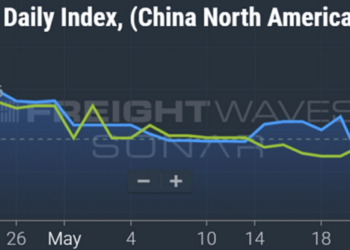
SONAR: Van Outbound Tender Rejection Index (VOTRI.USA) for 2026 (blue shaded area), 2025 (yellow line), 2024 (green line) and 2023 (pink line). A proxy for truck capacity, the tender rejection index shows the number of dry van loads being rejected by carriers. Current tender rejections show a tightened truckload market. To learn more about SONAR, click here.
Carriers looking for a commitment
While regulatory changes are mostly impacting small operators—the highly fragmented portion of the market willing to accept cheap rates—the upper end of the market has also undergone a change in the way they allocate equipment. After a historically long downturn, and an even longer stretch of outsized cost inflation, large carriers are less willing to gamble on high-priced tractors.
For several quarters, public carriers have been trimming their fleet counts to improve utilization and cut costs. Fourth-quarter reports highlighted replacement-level equipment capex plans for 2026, with most carriers emphasizing that any growth-related spend would only occur in dedicated operations. Fleets are opting for the safety of tying up equipment through long-term contracts where their employees are deeply embedded in customer operations.
Schneider National (NYSE: SNDR) said it’s unlikely to invest in its network (one-way) fleet as the unit hasn’t been profitable for a couple of years. The company said that portion of the TL market has become too commoditized in an appearance at the Citi conference on Wednesday. Schneider’s dedicated business (8,500 tractors) now accounts for 70% of its total TL revenue compared to just 34% prior to the pandemic.
The company is planning to keep its truck count flat this year, essentially “doing more with less.” It will also use an improving supply-demand backdrop to replace low-margin customer accounts. While it prefers the stability dedicated contracts provide, spot exposure in its network business is set at historical highs as it looks to cash in on the material runup in spot rates.
Werner is completely overhauling its one-way operation, which has been a drag on margins. Leathers said dedicated operations outperform one-way operations in eight years of any 10-year stretch. The dedicated segment of the market features “large, well-capitalized” carriers that “follow the rules.” Also, the dedicated space continues to be consolidated through M&A, which could be a tailwind for pricing.
The restructuring includes reallocating assets into more profitable one-way offerings like expedited, cross-border, and long-haul delivery using driver teams. Werner’s one-way fleet stood at nearly 3,300 tractors in 2022 but ended 2025 with less than 2,400 units.
The restructuring announcement followed Werner’s acquisition of dedicated carrier FirstFleet at the end of January. The $283 million deal added over 2,400 tractors and $615 million in revenue. Werner is now the fifth-largest dedicated provider in the U.S., with roughly 7,400 trucks. Over 70% of its TL fleet is tied to a dedicated agreement.
J.B. Hunt Transport Services (NASDAQ: JBHT) reiterated a long-term goal to add 800 to 1,000 trucks (net) each year to its dedicated fleet (currently 12,600 units). Appearing at the Barclays 43rd Annual Industrial Select Conference in Miami on Tuesday, the company said any growth-related capex in 2026 will most likely be slated to dedicated equipment.
The company was one of the first to transition assets out of commoditized TL to dedicated configurations. Today, its asset-light TL segment uses independent contractors to haul freight in J.B. Hunt trailers. (Carriers are more comfortable taking a risk on trailers, which represent about one-fourth of the cost of a tractor.)
Covenant Logistics (NYSE: CVLG) tightened capex plans in the new year as it intentionally shrinks its fleet to improve truck utilization and margins. The company said on a quarterly call at the end of January, that it will continue to look for opportunities to grow its specialized dedicated business as it lessens exposure to generic TL services.
Leathers said companies were forced to set up private fleets during the pandemic to keep their supply chains humming. That took freight from the for-hire market, but that business is coming back as those companies now face equipment replacement decisions at higher price tags. Also, some firms no longer want to operate a complex TL network as their supply chains become more time sensitive. He said more private fleets are viewing outsourced dedicated operations as a “safe haven.”
Werner is eyeing 300 to 500 basis points of operating margin improvement in dedicated during the next upcycle. It normally sees margins advance between 200 and 400 bps. The dedicated segment is operating at a high-single-digit margin currently. The company’s TL margin, inclusive of dedicated and one-way, was just 1.8% (adjusted) last year.
Mid-single-digit rate increases for starters?
“There isn’t a player in the entire industry right now that’s anywhere near in danger of being challenged by a customer relative to their margin levels,” Leathers said. He believes a 500-bp margin move is required before “reinvestability” returns, meaning no one is buying assets ahead of demand, at least for a while. That type of margin move could take a “couple of years.”
Werner’s 2026 guidance assumes mid-single-digit contractual rate increases in one-way, and low- to mid-single-digit increases in dedicated. The actual guide is noisy: one-way revenue per total mile is projected to be flat to up 3% year over year in the first half, while dedicated revenue per truck per week is forecast to be down 1% to up 2% y/y in 2026. There is a lag when implementing new contract rates and slightly more than 50% of its contracts will be renegotiated in the first half. Efforts to extend length of haul will impact one-way rate-per-mile results, while the FirstFleet acquisition will be a drag on the dedicated yield metric.
Following three consecutive years of $50 million in annual cost takeouts, Werner is pricing freight above inflation for the first time in over two years.
Leathers said virtually all the recent tightening in the spot market has been supply driven. He said tender rejections are likely still in the low-double-digit range, in the “lowest volume month of the year,” when backing out the impact of January’s storms (possibly 4 to 5 percentage points, according to Leathers).
He also sees the chance for a modest demand inflection given low inventory levels, bigger tax rebates and the recent turn in manufacturing data. (Trade policy remains a wild card even after Friday’s Supreme Court ruling.)
“All of the arrows are pointing in various degrees of up, but up and to the right, at a time which is bid season,” Leathers said. “I think expectations are set that we need rate relief as an industry and at Werner.”
SONAR: National Truckload Index (linehaul only – NTIL.USA) for 2026 (blue shaded area), 2025 (yellow line), 2024 (green line) and 2023 (pink line). The NTIL is based on an average of booked spot dry van loads from 250,000 lanes. The NTIL is a seven-day moving average of linehaul spot rates excluding fuel. Spot rates stepped higher through peak season as new constraints on the driver pool took hold. Severe winter weather amid a tighter capacity backdrop kept rates elevated in recent weeks.
Schneider President and CEO Mark Rourke said spot pricing is still “very attractive,” especially in the Midwest and Northeast, even as the bad weather has passed. He believes “the staying power is a very good signal” and that the current administration is serious about safety and removing the bad players. He expects a “steady and consistent attrition of capacity” moving forward.
“I think there’s a lot of hope that this has been exacerbated by the weather and this is going to go back and we have another year of … stability relative to what their [shipper] pricing objectives are,” Rourke said. “I think that’s maybe wishful thinking.”
Schneider is targeting mid-single-digit contractual rate increases. Certainly, changes in customer mix, a need to protect high-density lanes and prior-year comps (or how much a shipper paid last year) are factors. The carrier noted an uptick in mini bids as customers are trying to move freight under contract.
“We will not be lagging where the opportunities arise, whether that be in the spot market or contract,” Rourke said. He hedged by adding, that it’s still “way too early to call it,” but also left the door open for larger increases in the back half of the year if the current spot trends hold.
Knight-Swift Transportation (NYSE: KNX) said some shippers are moving freight to asset-based carriers in efforts to lockdown capacity. On a quarterly call in January, it said it is targeting low- to mid-single-digit contractual rate increases (leaning toward the upper end) during the 2026 bid season.
Covenant said supply and demand may already be balanced. It expects low- to mid-single-digit contractual rate increases in its expedited offering, with the impacts appearing in first-quarter results.
More FreightWaves articles by Todd Maiden:
J.B. Hunt ‘a little bit more positive’
TL rates up again without help from volume
Estes Logistics expands with Key Trucking acquisition
The post 2026: The year TL carriers turn the tide? appeared first on FreightWaves.