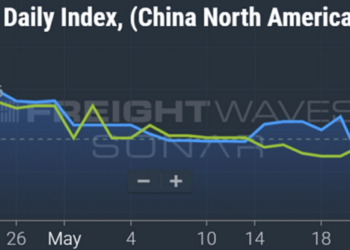


The peak shipping season is “well underway,” says an analyst, as box rates ride a wave of frontloading spurred by more tariffs, and spreading Mideast tensions push up fuel costs.
Rates hikes and assorted surcharges by carriers that took effect June 1 sent Asia-U.S. West Coast prices up by 51% in the latest week, according to the Freightos Baltic Index, to $4,836 per forty foot equivalent unit (FEU). Asia-U.S. East Coast prices rose 25% to $6,336 per FEU.
“These spikes are the sharpest one-week increases since sudden tariff changes spurred a June demand surge last year,” said Judah Levine, research chief for Freightos (NASDAQ: CRGO), in an update, though rates climbed more than $2,000 per FEU at that time.
“Trans-Pacific ocean peak season is well underway, with some observers pointing to frontloading ahead of the approaching tariff deadline as one driver of the early start,” Levine said. “And though the [Strait of] Hormuz closure hadn’t caused broad operational changes beyond the Gulf states in the first three months of the war, the rising price of oil may be another factor to the early peak season surge.”
While ocean volume is surging, the current SONAR Ocean Volume Index (right) substantially trails year-ago demand (left).
The United States Trade Representative announced new tariffs on 60 countries it said haven’t done enough to combat imports produced by forced labor. Separate Section 301 probes could see new tariffs on Brazil and 16 other trading partners, developments that Deborah Elms, head of trade policy at the Hinrich Foundation in Singapore, called “astonishing”.
“The tariff wall around the U.S. keeps rising,” Elms said. “This may seem like old news but the net effect will be to accelerate global supply chain shifts.”
A hearing is scheduled for July 7.
Contracted shippers could be pulling shipments forward ahead of an 80% jump in fuel surcharges starting in July when the quarterly Bunker Adjustment Factor is updated. “And indications that Asian manufacturers are set to increase prices due to higher input costs may also be driving some of the observed early demand bump,” he said.
The National Retail Federation recently revised its estimates, said Levine, moving the expected peak season to June from July a month ago. The NRF predicts June import volumes 5% higher than in May, dropping to 3% in July and continuing to cool through September.
In 2025 prices weakened by mid-June as shippers waited out unsettled demand. “Indications are that additional rate increases set for next week could push prices up further this time,” Levine said. “But NRF projections that demand will peak in June, make additional rate increases in July less likely.”
While Israel’s expanded attacks in Lebanon spread the Iran conflict from the Arabian Gulf to the Mediterranean, its brief exchange of military strikes with Iran did little to moderate upward pressure on rates due to higher fuel costs across the global supply chain.
Likewise, Iran’s threat to mobilize Houthi militia in Yemen to close the Bab el-Mandeb Strait between the southern Red Sea and Gulf of Aden “would not change much for freight if implemented, as the vast majority of container traffic continues to divert away from the Red Sea,” said Levine. “The added tension may push back the timeline for a [Strait of] Hormuz reopening, though the White House continues to assert that negotiations are making progress.”
The Houthi said this week that they will again block Israel-linked shipping from the Red Sea.
Read more articles by Stuart Chirls here.
Related coverage:
Containers say ‘hold my disruptions’ as ocean rates surge
Peak indicator: $2,600 increase on one U.S. shipping service
Box rates soar $1,000 in one week on peak
Swearing-in of commissioner returns U.S. maritime regulator to full strength
The post Frontload frenzy? New tariffs fueling early trans-Pacific peak season appeared first on FreightWaves.